

The Escalating Threat of Synthetic Identity Fraud in IDV

Overview
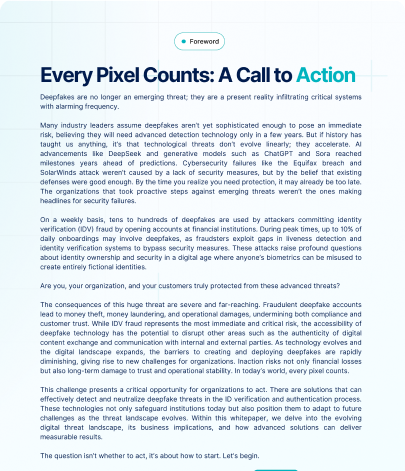
AI-driven fraud has escalated sharply between 2023-2025, with growth-stage IDV providers under mounting pressure to protect client trust while minimizing onboarding friction. Traditional liveness checks are collapsing against modern synthetic threats. Deepfake identity attacks now occur every 5 minutes globally, biometric bypass attempts surged 704% in 2023, and liveness checks fail 50% of the time in real-world cases. Average deepfake attacks cost $500,000 per incident, while EU AI Act, U.S., and APAC mandates now require detection beyond liveness. This report exposes the threat landscape and outlines defense strategies for protecting trust, compliance, and operational efficiency.
Why it matters

Why we made this report?

Legacy liveness detection validates behavior, not provenance, and injection attacks replace the camera stream itself. Device-based PAD assumes the video feed is genuine, but attackers now use virtual cameras, driver emulators, and signal-level manipulation that sits outside what PAD inspects. Despite this, many organizations underestimate how quickly synthetic identity fraud has escalated. We created this report to expose the fraud landscape, document why traditional liveness fails, and provide a defense framework that IDV providers can deploy to maintain trust and meet regulatory requirements.

Key Takeaways

Every 5 minutes
Deepfake identity attack occurs globally
Synthetic identity fraud now operates at unprecedented scale, targeting growth-stage IDV providers with automated attack tools.
704%
Growth in biometric bypass attempts (2023)
Attackers accelerated adoption of generative AI, advanced presentation methods, and sensor spoofing techniques throughout 2023.
50%
Failure rate of liveness checks in real-world cases
Device-based liveness cannot validate signal provenance, leaving IDV systems vulnerable to injection and stream replacement attacks.
$500,000
Average cost per deepfake attack incident
Organizations face massive financial impact from synthetic identity fraud, compounded by 40.7% higher customer churn after fraud slips.

Explore Key Findings

This report reveals how synthetic identity fraud has outpaced traditional defenses and why forensic-grade detection is now mandatory for IDV providers.

Generative AI attacks rose 88% YoY, with GANs and diffusion models bypassing liveness prompts

Sensor spoofing replicates biometric signals across modalities, overwhelming legacy defenses

EU AI Act, U.S. state laws, and APAC KYC mandates now require detection proof beyond liveness

Advanced presentation attacks use face-swap deepfakes and multi-point stream injection to bypass device-based liveness

24.5% human accuracy spotting high-quality deepfakes demonstrates detection requires automation

Forensic analysis + multimodal biometrics achieve >99% accuracy with <1s processing time

Defense strategies for synthetic threats

This report includes the three-tier fraud landscape (generative AI, advanced presentation, sensor spoofing), operational and compliance risk breakdowns, case studies from KnowBe4 incident and dark web operations, defense strategy frameworks with forensic analysis and multimodal biometrics, regulatory response timelines for EU AI Act and U.S. statutes, and operational benchmarks for accuracy, speed, user experience, injection resilience, and auditability. Access the complete framework for protecting IDV systems against escalating synthetic identity fraud.

+5 more

More Whitepapers to explore

Reports
Deepfakes have evolved from entertainment tools into precision fraud weapons. This white paper reveals how attackers exploit IDV gaps, and how leading organizations are closing them.
Reports
Adoption is global. Readiness is not. From the EU's deliberate approach to Latin America's urgency-driven innovation, regulatory trajectories differ dramatically while the threat remains universal.
Reports
Detection isn't about perfection, it's about measurable, consistent improvement. This study reveals how AI stays ahead of adversarial generation without sacrificing operational efficiency.