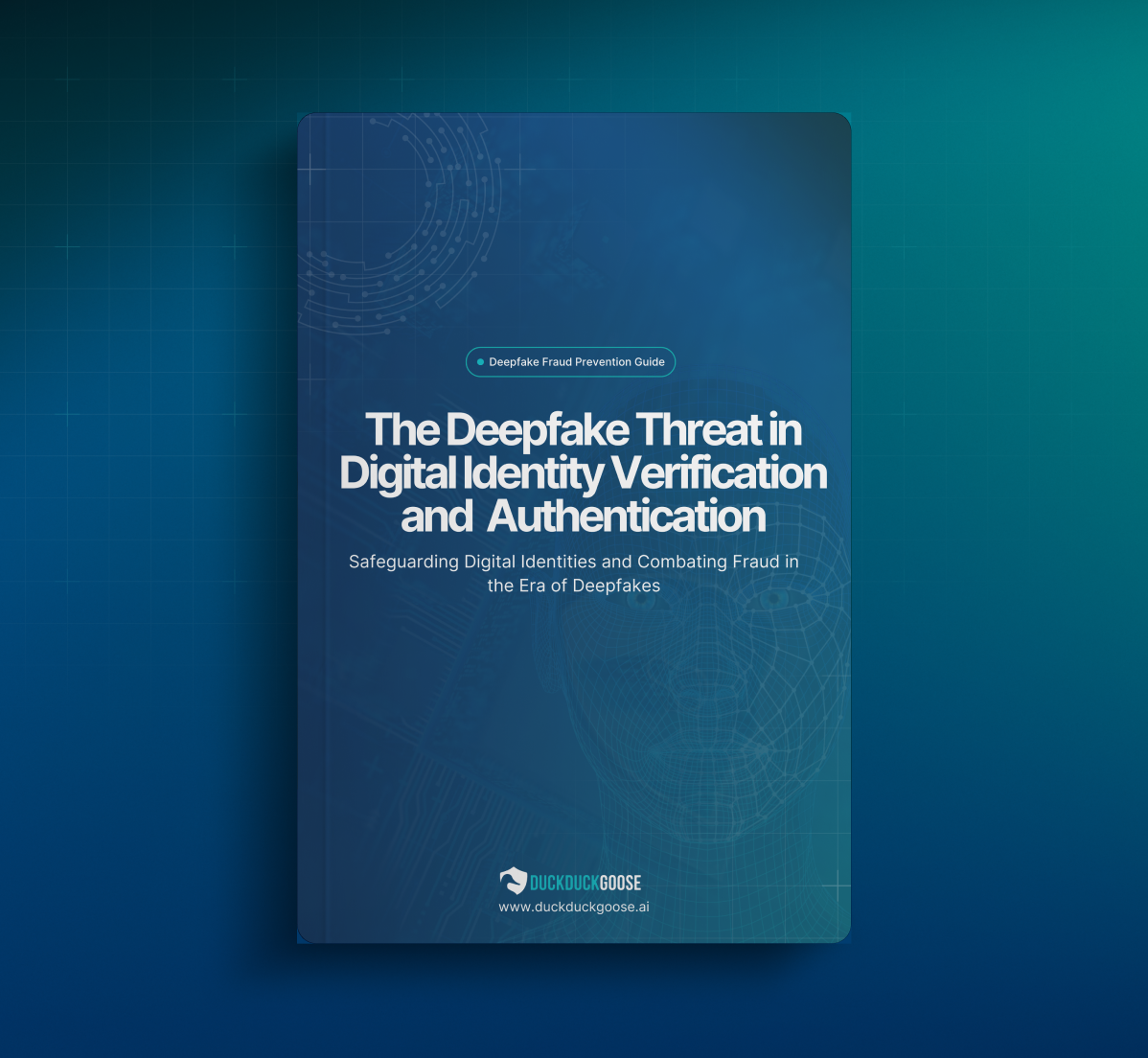

Technical Integration Guide: Deepfake Detection

Overview
Deploying deepfake detection doesn't require infrastructure overhaul or months-long timelines. DuckDuckGoose integrates in 1-5 days via Cloud API, Hybrid, or On-Prem architectures, delivering sub-1000ms latency with minimal pipeline disruption. Banking systems achieve 250ms at 96% accuracy, government deployments reach 450ms at 98%, and contact centers operate at 85ms with 92% detection rates. This guide provides technical teams with integration options, production benchmarks, API examples, and a 3-step roadmap for shipping detection capabilities in under four weeks, without sacrificing performance or security requirements.
Why it matters

Why we made this guide?

Technical teams often assume deepfake detection requires custom ML pipelines, extensive retraining, or infrastructure overhaul. In reality, detection integrates as a standard API call with sub-1000ms latency and production-ready accuracy. However, without clear integration guidance, teams face latency spikes, pipeline disruption, model drift, and scaling challenges. We created this guide to eliminate ambiguity, providing technical decision-makers with deployment options, performance benchmarks, and a proven roadmap for shipping detection in weeks, not months.

Key Takeaways

Sub-1000ms
Latency across all deployment architectures
Cloud API, Hybrid, and On-Prem options deliver production-ready performance without sacrificing speed or accuracy requirements.
1-5 day
Integration timeline for all deployment models
Cloud API prototypes in 1 day; Hybrid and On-Prem configurations deploy in 1-5 days with balanced performance and high-security options.
250ms
Latency at 96% accuracy in banking deployments
Real-world performance benchmarks demonstrate sub-second verification without compromising detection recall or precision.
4-week
Production deployment from PoC to live integration
Structured roadmap includes PoC/PoV validation, load testing, optimization, and API/Hybrid/On-Prem production rollout.

Explore Key Findings

This guide provides technical teams with everything needed to deploy deepfake detection without pipeline disruption or prolonged timelines.

Three integration options (Cloud API, Hybrid, On-Prem) match performance and security requirements

Async queuing and parallel stream architecture eliminate latency spikes and pipeline disruption

Horizontal load balancing enables scaling without degrading response times

Production benchmarks span banking (250ms/96%), government (450ms/98%), and contact centers (85ms/92%)

Automated retraining (3-6 month cycles) prevents model drift without manual intervention

3-step roadmap delivers production-ready detection in 4 weeks: PoC/PoV, load testing, production integration

Production-ready detection in four weeks

This guide includes integration option comparisons, production latency benchmarks across industries, Quick API example with request/response structure, challenges and solutions for latency, pipeline disruption, model drift, and scaling, plus a 4-week deployment roadmap from PoC to production. Access the technical framework for shipping deepfake detection without infrastructure overhaul.

+5 more

More Whitepapers to explore

Reports
Deepfakes have evolved from entertainment tools into precision fraud weapons. This white paper reveals how attackers exploit IDV gaps, and how leading organizations are closing them.
Reports
Adoption is global. Readiness is not. From the EU's deliberate approach to Latin America's urgency-driven innovation, regulatory trajectories differ dramatically while the threat remains universal.
Reports
Detection isn't about perfection, it's about measurable, consistent improvement. This study reveals how AI stays ahead of adversarial generation without sacrificing operational efficiency.