
Orthogonal Controls in Remote KYC: PAD, Deepfake Detection, and Injection Detection

Overview
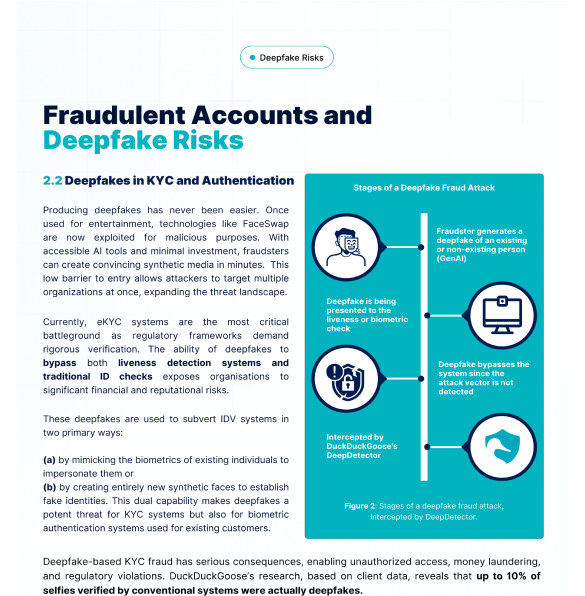
Remote KYC faces a new attack landscape requiring three independent control families working in concert. Presentation vectors deliver synthetic media to cameras, diffusion models generate faces, motion-transfer creates liveness. Injection vectors bypass cameras entirely, inserting media directly into SDKs and APIs. In H1 2025 production across EU and South America, DuckDuckGoose processed 60 million identity checks, flagging 750,000 synthetic-like cases and blocking 500,000 confirmed deepfakes. At scale, these ratios reveal hundreds of thousands of attempted synthetic onboardings in six months. Without layered defenses calibrated for diffusion-era threats, control stacks fail systematically.
Why it matters

Effective defense requires orthogonal control families

Single-layer defenses fail against synthetic identity attacks. PAD confirms human presence but misses deepfakes. Deepfake detection identifies synthetic media but can't validate stream integrity. Injection detection prevents bypass attacks but doesn't analyze content. Organizations need all three controls calibrated for diffusion-era threats where models generalize poorly to zero-day generators.

Key Takeaways

500K+
Confirmed deepfakes blocked in six months
Production deployment across EU and South America stopped 0.83% of all identity checks from deepfake-driven fraud attempts.
53%
Of deepfake attempts use 10-15 second clips
Short presentation windows exploit temporal gaps in PAD systems, requiring frame-level deepfake detection across brief sequences.
70%
Pure synthetic identities versus 30% impersonation
Most deepfake attacks use fully AI-generated faces rather than mimicking real individuals, complicating biometric matching.
750K+
Synthetic-like cases flagged for review
At 1.25% prevalence, hundreds of thousands of borderline cases require manual analyst review without automated detection.

Explore Key Findings

Mitigation requires layered controls calibrated for diffusion-era threats. Deepfake detection, PAD, and injection detection must work in concert to address systematic control stack weaknesses.

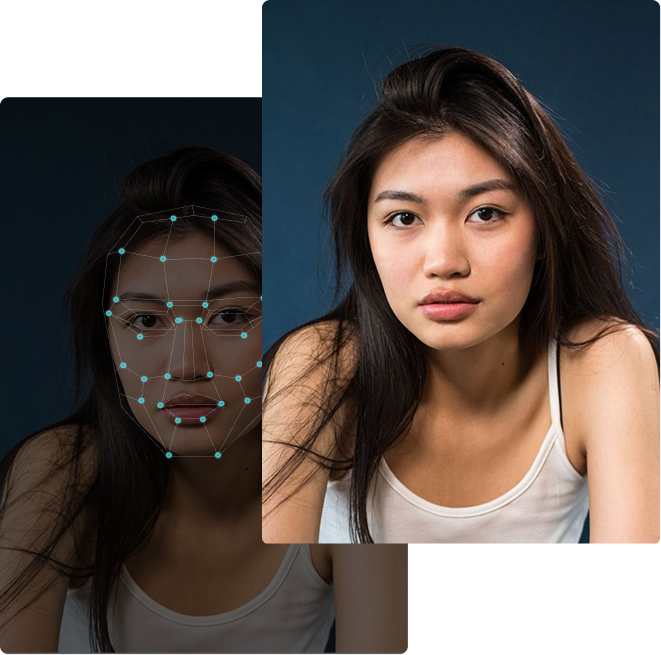
Diffusion models produce unnaturally uniform lighting, skin, and shading artifacts

First-order motion artifacts reveal overly smooth lip and cheek movements

Rolling-shutter and photometric lag expose temporal mismatches during motion

Double-compression traces indicate export or processing steps in synthetic pipelines

GAN-era trained models generalize poorly to diffusion and motion-transfer outputs

Injection vectors remain blind to PAD systems without SDK attestation and entropy validation

Taxonomy meets operational reality

This technical brief includes attack classification frameworks, production telemetry from 60 million identity checks, detection challenge analysis for diffusion-era threats, and layered control architecture recommendations. Access the operational data security architects and fraud prevention teams use to calibrate defenses against synthetic identity attacks.

+5 more

More Whitepapers to explore

Reports
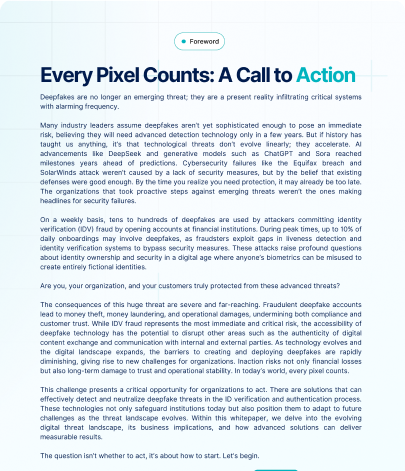
Deepfakes have evolved from entertainment tools into precision fraud weapons. This white paper reveals how attackers exploit IDV gaps, and how leading organizations are closing them.
Reports
Adoption is global. Readiness is not. From the EU's deliberate approach to Latin America's urgency-driven innovation, regulatory trajectories differ dramatically while the threat remains universal.
Reports
Detection isn't about perfection, it's about measurable, consistent improvement. This study reveals how AI stays ahead of adversarial generation without sacrificing operational efficiency.