

Bypassing Liveness: Evidence of IDV System Failures

Overview
Liveness detection alone is no longer sufficient. Academic and industry tests show bypass rates of 80-100% for replay, injection, and deepfake attacks across commercial IDV systems. Engineering teams face $355K-$1.06M in annual retraining costs, while attackers adapt faster than models can be updated. Cross-database testing reveals HTER rates up to 0.514, motion-based PAD fails nearly 100% of the time against Virtual U replay frameworks, and 17 out of 20 commercial systems successfully process spoof attempts. This report exposes documented liveness failures and demonstrates why forensic-grade, multi-modal detection is now mandatory for future-ready identity verification.
Why it matters

Why we made this report?

Liveness detection remains the default defense for most IDV systems, but attackers now bypass it at every stage of the pipeline. Organizations rely on motion-based PAD, challenge-replay protocols, and biometric matching without realizing these methods collapse under real-world spoofing conditions. Despite this, many vendors still claim "liveness detection" as sufficient protection. We created this report to expose the evidence behind liveness failures and demonstrate why forensic analysis, multi-modal biometrics, and adaptive models are required to outpace adversaries.

Key Takeaways

80-100%
Bypass rates for replay, injection, and deepfake attacks
Academic and industry testing shows commercial liveness systems repeatedly fail under real-world spoofing conditions.
Up to 0.514
Cross-database HTER
Models collapse on unseen attacks, demonstrating that liveness detection cannot generalize beyond training distributions.
Nearly 100%
Bypass rate using Virtual U replay framework
Motion-based PAD fails when attackers use video-on-screen replay techniques with biometric turn simulation.
17/20
Commercial systems process spoof attempts successfully
100% success rate with video replays demonstrates systemic vulnerability across the IDV industry.

Explore Key Findings

This report reveals how attackers bypass liveness at every stage of the IDV pipeline, and why forensic detection is essential for future-ready systems.

Attackers exploit 7+ pipeline stages: capture, pre-processing, feature extraction, liveness, matching, and authorization

Pixel-level artifacts and GAN fingerprints expose deepfakes beyond human-visible checks

Temporal consistency analysis detects synthetic jitter across frames

GAN-generated deepfakes with AI-controlled blinks/expressions bypass motion-based PAD

PRNU sensor noise validation catches injected and replayed streams

Metadata and network traces expose injection anomalies at the API layer

Forensic detection for evolving threats

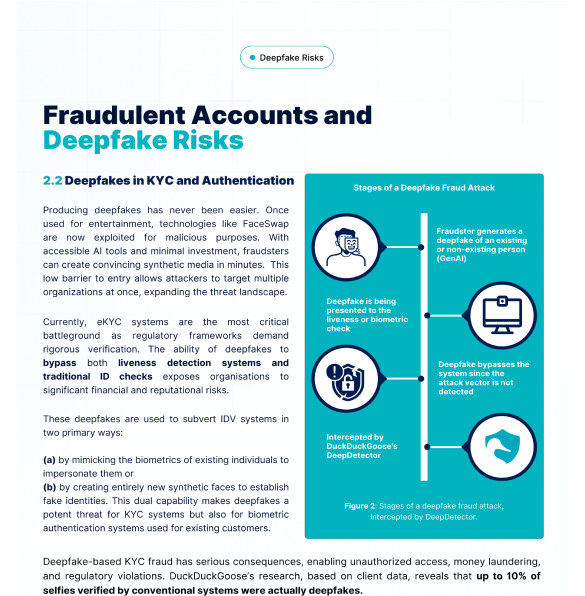
This brief includes the full biometric attack flow diagram, documented bypass evidence from cross-database and motion-based PAD testing, forensic advantage breakdowns for pixel-level analysis and GAN fingerprinting, and engineering burden calculations for retraining costs and adversarial ensembles. Access the technical framework for evaluating liveness vulnerabilities and implementing multi-modal defenses.

+5 more

More Whitepapers to explore

Reports
Deepfakes have evolved from entertainment tools into precision fraud weapons. This white paper reveals how attackers exploit IDV gaps, and how leading organizations are closing them.
Reports
Adoption is global. Readiness is not. From the EU's deliberate approach to Latin America's urgency-driven innovation, regulatory trajectories differ dramatically while the threat remains universal.
Reports
Detection isn't about perfection, it's about measurable, consistent improvement. This study reveals how AI stays ahead of adversarial generation without sacrificing operational efficiency.