
Audit-Ready Synthetic Media Compliance Checklist

Overview
Procurement teams in banking, telecom, and fintech are increasingly requiring synthetic media detection proof in RFPs. Vendors now face mandatory requirements for ISO/IEC 30107-3 certification, SOC 2 Type II audits, EU AI Act Article 50 compliance by 2026, and audit logs with 3-7 year retention. High-priority criteria include independent testing frameworks, explainable AI, documented FAR <0.1% and FRR <2.0%, and sub-2 second verification with 99.9% uptime SLAs. This checklist provides procurement teams with a scoring framework to assess vendor audit-readiness and compliance with evolving global standards.
Why it matters

Why we made this checklist?

RFPs for identity verification and fraud prevention now include mandatory synthetic media detection requirements. Procurement teams need objective criteria to evaluate whether vendors are audit-ready and compliant with evolving standards like EU AI Act Article 50, SOC 2 Type II for biometric data, and ISO/IEC 30107-3 certification. Without a standardized assessment framework, organizations risk selecting vendors that lack regulatory compliance, explainable AI capabilities, or performance documentation. We created this checklist to provide procurement teams with clear pass/fail criteria, enabling faster vendor evaluation while ensuring audit-readiness and global compliance.

Key Takeaways

ISO/IEC 30107-3
Certification now mandatory in RFPs
Procurement teams require iBeta Level 2 or above certification with APCER ≤1.0% and BPCER ≤15% for biometric liveness validation.
SOC 2 Type II
Audits covering biometric data scope required
Vendors must demonstrate compliant storage, processing, and deletion practices for biometric data through independent audits.
Article 50
Of EU AI Act compliance required by 2026
Machine-readable detection of synthetic content must be implemented by 2026 to meet EU regulatory mandates.
3-7 year
Audit log retention with decision trails mandatory
Regulatory compliance requires UTC timestamps, transaction IDs, device fingerprinting, and full decision trails for forensic review.

Explore Key Findings

This checklist reveals the mandatory and high-priority criteria procurement teams use to evaluate vendor compliance and audit-readiness.

ISO/IEC 30107-3, SOC 2 Type II, EU AI Act Article 50, and audit log retention are now mandatory requirements

Explainable AI with human-readable justifications required for verification outcome transparency

Sub-2 second real-time verification with 99.9% uptime SLAs expected for production deployments

Independent testing frameworks must reflect dynamic deepfake-fraud landscape, not static benchmarks

Documented FAR <0.1% and FRR <2.0% performance metrics mandatory for qualified vendor status

Qualified vendors must achieve 100% of critical requirements + ≥80% of high-priority criteria

Vendor evaluation framework for RFPs

This checklist includes mandatory critical requirements (ISO certification, SOC 2 audits, EU AI Act compliance, audit logs), high-priority criteria (independent testing, explainable AI, FAR/FRR documentation, real-time SLAs, voice cloning detection, regulatory reporting, geographic redundancy), and scoring framework with pass/fail thresholds for qualified, watchlist, and disqualified vendor categories. Access the complete compliance assessment framework for evaluating synthetic media detection vendors in RFPs.

+5 more

More Whitepapers to explore

Reports
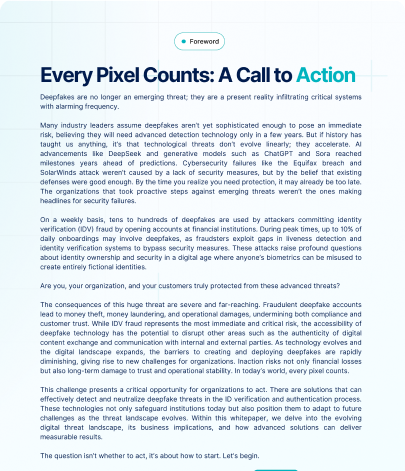
Deepfakes have evolved from entertainment tools into precision fraud weapons. This white paper reveals how attackers exploit IDV gaps, and how leading organizations are closing them.
Reports
Adoption is global. Readiness is not. From the EU's deliberate approach to Latin America's urgency-driven innovation, regulatory trajectories differ dramatically while the threat remains universal.
Reports
Detection isn't about perfection, it's about measurable, consistent improvement. This study reveals how AI stays ahead of adversarial generation without sacrificing operational efficiency.