

















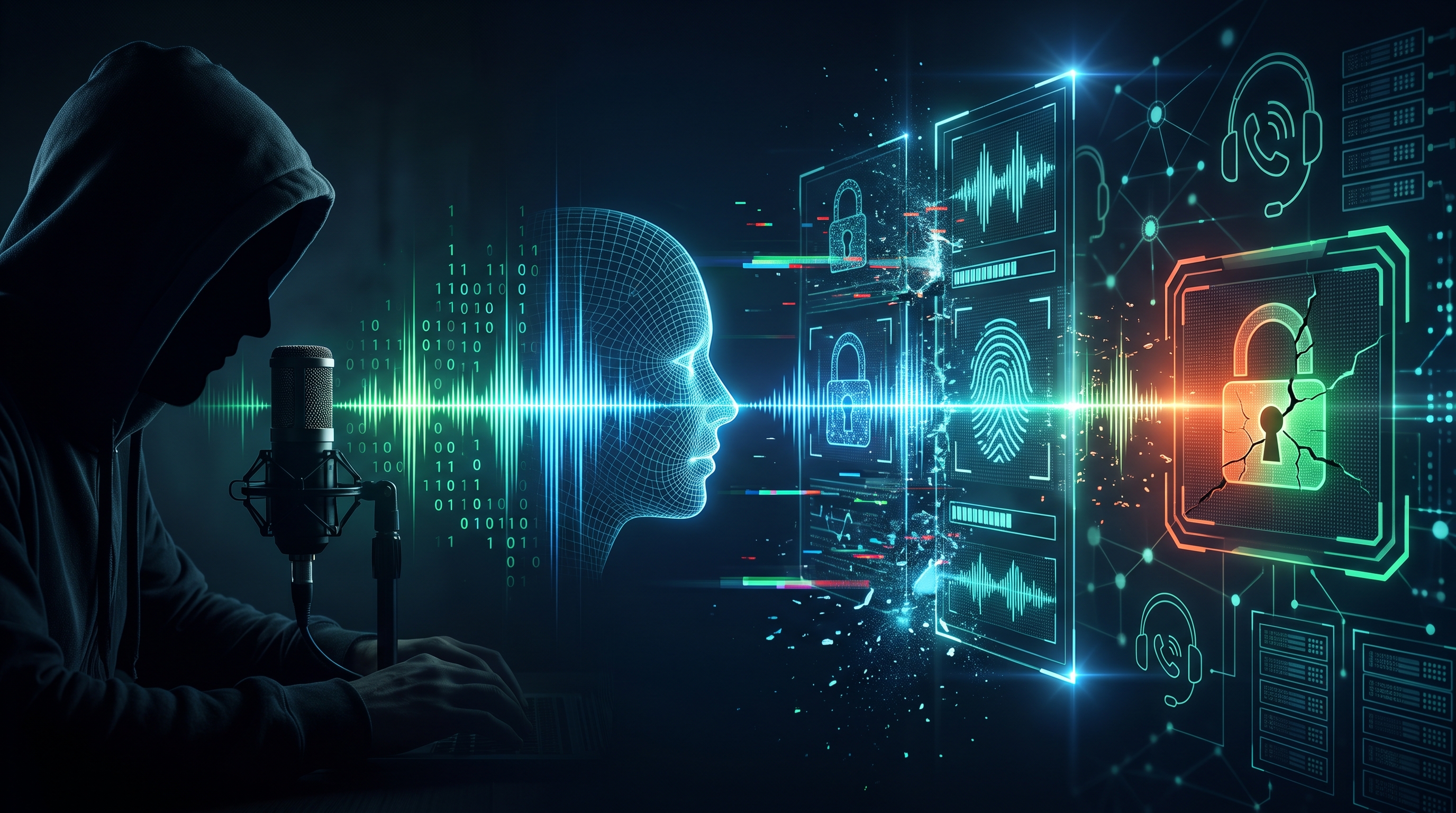


In 2023, Pindrop measured roughly one deepfake attack against a contact centre every two days. By 2024, that number had risen to approximately seven deepfake attacks per day, a trajectory that put synthetic voice fraud in banking up 149% and in insurance up 475% over the same period. The attack class driving the numbers is the voice clone, delivered against the voice biometric authentication that call centres at HSBC, Citibank, Charles Schwab, Morgan Stanley, TD Bank, Bank of Ireland, National Australia Bank, ANZ, and most major financial institutions have used as a convenience-driven authentication factor since the mid-2010s.
The underlying technology collapse is specific. Voice cloning in 2026 requires as little as three seconds of source audio, with ElevenLabs, OpenAI Voice Engine, PlayHT, and a widening set of consumer and specialist tools delivering clones that pass speaker verification for most enrolled voiceprint systems. Nuance and Verint, two of the three incumbent vendors in the call-centre voice biometric market, published internal research in late 2024 acknowledging bypass rates greater than 90% against their own biometric engines for high-quality clones. The Federal Reserve issued informal guidance in Q1 2025 recommending against voice-only authentication for account access. US Senator Sherrod Brown's Senate Banking Committee inquiry pressed banks on their voice authentication practices. The European Banking Authority raised specific concerns about voice biometrics meeting strong authentication requirements under PSD2. 91% of US banks now report rethinking voice biometric authentication.
This guide walks through how voice clones actually bypass call-centre authentication in 2026, the six attack vectors operating in production, the documented cases that establish the pattern, and the detection stack that pushes back. It is written for contact centre fraud leads, voice authentication programme managers, CISOs at financial services firms, and anyone evaluating whether their voice biometric deployment still passes the 2026 threat model.
- Pindrop measured deepfake attacks on contact centres rising from approximately one every two days in 2023 to approximately seven per day in 2024, with synthetic voice fraud in banking up 149% and in insurance up 475% over the same period.
- Voice cloning in 2026 requires as little as three seconds of source audio, defeating speaker verification systems that had been the baseline convenience-authentication factor across major US and European banks.
- Nuance and Verint, two of the three incumbent voice biometric vendors, published internal research in late 2024 acknowledging more than 90% bypass rates against their own biometric engines for high-quality clones.
- 91% of US banks now report rethinking voice biometric authentication; the Federal Reserve issued informal guidance in Q1 2025 recommending against voice-only authentication for account access.
- Senator Sherrod Brown's Senate Banking Committee inquiry pressed banks on their voice authentication practices; the EBA raised specific concerns about voice biometrics meeting PSD2 strong authentication requirements.
- The 2019 UK energy firm case ($243K via cloned CEO voice) and the 2020 UAE director voice clone ($35M) are the public reference incidents for the broader threat category, with the attack economics now substantially cheaper per attempt.
- Voice phishing attacks rose 442% in 2025 with 70% of organisations reporting at least one incident, driving the shift from biometric-dependent authentication to a layered model.
- The 2026 detection posture requires dedicated voice deepfake detection running alongside the voice biometric, phoneprinting and device fingerprinting, out-of-band verification, and agent training on cross-channel verification techniques.
What Call-Centre Voice Authentication Actually Does
Voice biometric authentication at a call centre works by comparing a caller's voice during the call against an enrolled voiceprint sample previously recorded for that customer. The system produces a similarity score; if the score crosses a threshold, the caller is treated as authenticated and the call proceeds with elevated trust, typically skipping the knowledge-based authentication (KBA) questions that would otherwise be required.
The deployment has two main variants. Passive voice biometrics runs continuously during the call without caller action, matching the caller's voice to the enrolled voiceprint as they speak naturally. Active voice biometrics requires the caller to speak a specific challenge phrase ("My voice is my password" being the historical example) that the system matches against an enrolled recording of the same phrase. Passive is the dominant 2026 deployment pattern because it is more convenient for the caller; active is residual at some institutions and plays a role in step-up flows.
The vendor landscape has consolidated around Nuance (now part of Microsoft), Pindrop, Verint, NICE, and LumenVox. Specific deployments include HSBC Voice ID, Citibank Voice Biometric, Charles Schwab, Morgan Stanley, TD Bank, Bank of Ireland, National Australia Bank, ANZ Voice ID, and First Direct. In the US, Senator Sherrod Brown's Senate Banking Committee inquiry specifically named Morgan Stanley, Charles Schwab, and TD Bank among the institutions pressed on voice authentication practices.
The architectural assumption behind voice biometrics is that producing a convincing impersonation of a specific person's voice is expensive, requires specialised skills, and leaves artefacts that the detection system can catch. Against the 2015-2022 threat model (recorded playback, impressionists, voice changers), the assumption held reasonably well. Against the 2024-2026 threat model (three-second AI voice clones from public audio), the assumption no longer holds.
Why 2026 Broke Voice Authentication
Three structural shifts moved voice biometric authentication from "a reasonable convenience factor" to "a liability if deployed as the only authentication factor" between 2023 and 2026.
The first is the source audio collapse. ElevenLabs, OpenAI Voice Engine, PlayHT, and parallel tools in 2026 produce usable voice clones from approximately three seconds of source audio. Five seconds of a podcast appearance, a voicemail greeting, or a recorded meeting is typically sufficient to clone a customer's voice at a quality that passes speaker verification. Sardine's 2026 Fraud and AML Report captures the consequence directly: "A voice is now closer to a stealable credential than to a reliable proof of identity."
The second is the attack frequency growth. Pindrop's data (one attack every two days in 2023, seven per day in 2024) is the most-cited measurement of the trajectory. Voice phishing attacks rose 442% in 2025 across the broader category, and 70% of organisations have reported at least one voice phishing attempt. The attacker economics work because the per-attempt cost is tiny (the clone and the phone call) and the per-success payoff is substantial (the authenticated account access, the authorised wire transfer, the account change that enables further fraud).
The third is the vendor and regulator response catching up. Nuance and Verint's late-2024 internal research acknowledging more than 90% bypass rates against their own biometric engines is a public industry concession. The Federal Reserve's Q1 2025 informal guidance recommending against voice-only authentication for account access is a regulatory signal. Senator Sherrod Brown's inquiry put specific institutions on public record about their voice authentication practices. The EBA's concerns about PSD2 strong authentication create direct regulatory exposure for European deployments.
The architectural response is the layered authentication stack: voice biometrics as one passive signal, combined with phoneprinting, device fingerprinting, behavioural signals, and step-up challenges, so that no single factor can be cloned to bypass authentication. 91% of US banks report moving in this direction; the specific vendor configurations vary.
The Six Voice Clone Attack Vectors
1. Passive Voice Biometric Bypass in IVR
The dominant 2026 attack targets IVR systems that use passive voice biometrics as a login factor. The attacker calls the institution's IVR, the system passively collects the caller's voice during the initial prompts, and the collected audio is matched against the enrolled voiceprint. A high-quality clone of the target customer's voice feeds through a virtual audio device into the phone call; the IVR hears what sounds like the enrolled customer; the authentication passes and the caller gains the elevated trust level that voice biometric authentication confers.
The Systems Hardening 2026 defence analysis describes the mechanism explicitly: "Banking, telecom, and government IVR systems that use passive voice biometrics, where the customer's voiceprint is matched against enrolment without requiring a specific challenge phrase, are entirely bypassed by feeding the clone's audio through a virtual audio device into the phone call." The attack is fully automated once the clone is produced, which is why Pindrop's seven-attacks-per-day figure represents industrial-scale fraud rather than individual attempts.
2. Active Voice Challenge Phrase Bypass
For institutions that use active biometrics (requiring the caller to speak a specific challenge phrase), the attack is marginally harder but still routine. The attacker generates the challenge phrase through the voice clone, either live (if the phrase is known in advance, as many institution-specific phrases are published or recoverable) or through pre-recorded clips if the phrase set is predictable.
The attack works because the active biometric check is still a speaker-verification problem: match the audio to the enrolled voiceprint. A high-quality clone of the enrolled voice speaking the required phrase passes the check regardless of whether the phrase was the specific enrolled one or a close variant. Active biometrics is moderately more resistant to opportunistic clones than passive, but not to targeted attacks against a specific enrolled customer.
3. Agent Social Engineering with Cloned Voice
The vector that often matters more than IVR bypass is social engineering with a cloned voice against a human agent. The caller, presenting as the customer, asks the agent for a specific action (account change, large transfer, password reset). The agent hears what sounds like the customer and treats the call with the trust the customer's established voice would warrant.
Human agents are specifically vulnerable because they are trained to provide good customer service, which means accepting the caller's voice at face value and completing the requested action. The Systems Hardening analysis puts it plainly: "Updating IVR deepfake detection without updating helpdesk human procedures. Automated IVR voice biometric bypass is real, but humans answering helpdesk calls are the larger attack surface in most organisations." Agent training on cross-channel verification, out-of-band callback, and refusing high-risk requests on voice alone is the control; the training deficit is the gap.
4. Executive Impersonation for Wire Authorisation
The vector that produced the highest per-incident losses targets the corporate treasury and private banking workflows where executive voice authorisation enables large wire transfers. The 2019 UK energy firm case (approximately $243,000 via cloned CEO voice calling a subordinate) and the 2020 UAE director voice clone case (approximately $35 million via cloned company director calling a bank manager) are the public reference incidents, both predating the current wave of consumer voice cloning tools.
In the 2026 contact centre context, the attack lands at private banking relationship managers, corporate treasury support lines, and high-value customer teams who recognise the executive's voice and are trained to act on recognised voice authorisation. The architectural gap is specifically that recognition of a familiar voice is now a weak signal, not a strong one.
5. Family Emergency Scam Against Call-Centre Staff
A variant that specifically targets call-centre staff rather than customers uses cloned family-member voices to produce distress calls that pressure the agent into an unauthorised action or information disclosure. The attack is well-documented in consumer-side reporting (the "grandparent scam" variant that AARP and FTC consumer protection materials describe), but the staff-side variant is a specific social engineering vector where the agent becomes the target rather than the attack path.
6. Fully Automated Vishing with LLM Conversation Agent
The 2026 escalation combines the voice clone with an LLM-powered conversation agent, producing fully automated vishing systems that can conduct extended dialogue with a human agent or an IVR without human operator involvement. The clone provides the voice; the LLM provides the conversational responses. The attack scales to a degree that human-operated voice cloning cannot, and it enables campaigns against multiple institutions simultaneously.
Proofpoint's 2026 reporting documents that phishing platforms are now fully automated, with a single operator running campaigns against multiple brands simultaneously with AI agents that extract verification codes without human involvement. The voice equivalent of this capability is the attack class that will define 2026-2027 contact centre threat models.
Documented Cases and Industry Evidence
The public case record that frames the attack category runs from 2019 through 2026.
The 2019 UK energy firm case is the earliest widely-cited incident. A subordinate was deceived by what the subordinate believed was the parent company CEO's voice, demanding an urgent wire transfer of approximately $243,000 to a Hungarian supplier. The transfer was executed; the fraud was identified when the subordinate noticed inconsistencies in subsequent calls. The case established that voice cloning was already operationally capable of defeating executive voice recognition in 2019, before the consumer voice cloning tools of 2024-2026 made the attack dramatically cheaper.
The 2020 UAE director case scaled the attack. A UAE bank manager received a phone call from what sounded like a company director known to the bank, requesting approximately $35 million in transfers for an acquisition. The call was accompanied by what appeared to be legitimate supporting email documentation. The transfers were executed; the fraud was identified when the actual director confirmed no such request. This remains the largest single-incident voice clone fraud in public records.
The Hong Kong Arup case (2024, approximately $25.6 million) is primarily a video deepfake case but the voice layer was integrated into the multi-person video conference deepfake. The case is the reference for how voice deepfakes integrate with video deepfakes in the broader deepfake-fraud threat model.
US healthcare provider IVR bypass cases through 2024-2025 are the specific industry evidence in a sector adjacent to banking. Multiple providers reported voice authentication bypass in their IVR systems, which drove parallel investigation across banking contact centres and ultimately fed into the Federal Reserve's Q1 2025 informal guidance.
Nuance and Verint's late-2024 internal research acknowledging more than 90% bypass rates against their own biometric engines is the most direct industry evidence of the scale of the problem. When the vendors of the biometric systems publicly acknowledge the bypass rate against their own products, the regulatory response is set up to be rapid.
Where Voice Clone Attacks Land in the Call-Centre Pipeline
Understanding where each attack class lands in the standard call-centre authentication pipeline determines where control investment matters.
At inbound call reception, the control layer is phoneprinting and device fingerprinting. Pindrop's Phoneprinting (and parallel products from NICE and others) analyses call-origination signals (ANI, carrier information, network path characteristics, call quality signatures) to flag high-risk callers before the authentication conversation starts. For voice clone attacks, this layer catches attacks that originate from VoIP providers associated with fraud, from unexpected geographies, or from carriers with known high fraud rates.
At IVR voice biometric enrolment check, the control is dedicated voice deepfake detection running alongside the voice biometric. The biometric verifies the speaker matches the enrolled voiceprint; the deepfake detector verifies the audio is not synthesised. The two models answer different questions: speaker identification versus generation detection, and both are needed because a successful clone passes the former while being caught by the latter.
At agent conversation, the controls are agent training, procedural requirements, and real-time deepfake detection running on the agent-channel audio. Agent training should specifically address the pattern of cloned voices requesting high-risk actions; procedural requirements should specifically mandate out-of-band callback verification for certain transaction types regardless of apparent voice recognition.
At step-up authentication (knowledge-based questions, one-time passwords, push notifications to enrolled mobile apps), the control is confirming that the step-up channel is independent of the voice channel. A knowledge-based question that an attacker with breach data can answer is not a step-up; a push notification to the enrolled mobile app with biometric confirmation is.
At transaction authorisation, the control is transaction-pattern monitoring. Unusual beneficiaries, round-number amounts, specific keyword patterns in the transaction reference, and timing signals are the same signals that catch deepfake-initiated wire fraud in the correspondent banking threat model, and they apply equally at the call-centre transaction surface.
How to Detect and Stop Voice Clone Attacks
A resilient 2026 call-centre authentication posture against voice clone attacks operates across six control families.
Dedicated voice deepfake detection running alongside the voice biometric is the first-layer response. The deepfake detector answers "is this audio generated" independently of the biometric answering "does this audio match the enrolled voiceprint." The two models should run in parallel, with either one flagging as sufficient to trigger step-up. The evaluation metric that matters is generalisation accuracy against voice generators the detection system has not been trained on, because the next attacker's clone will not use the generator that was dominant three months ago.
Phoneprinting and device fingerprinting at call origination addresses the pattern layer. The Pindrop Phoneprinting product and parallel vendor offerings analyse signals that are independent of the audio content. Voice clone attacks typically originate from infrastructure that produces specific phoneprint signatures (VoIP providers, specific carrier paths), and these signatures catch attacks regardless of the voice clone's quality.
Multi-factor authentication beyond voice is the architectural control that the Federal Reserve's Q1 2025 guidance pushed. Voice biometrics as a single factor is insufficient; voice plus a non-voice factor (knowledge, possession, biometric from another modality) is the minimum 2026 baseline. The specific implementation varies by institution, but the principle is that voice cannot be the entire authentication decision.
Agent training on cross-channel verification is the human-layer control that addresses the social engineering vector (attack pattern 3 above). Agents should be trained to recognise the pattern of voice clone attacks (urgency, unusual request types, pressure to bypass procedure) and to default to out-of-band callback verification rather than voice-only trust. The training is the specific gap the Systems Hardening analysis identified: IVR detection improvement without parallel agent training is architecturally incomplete.
Cross-channel verification for high-risk transactions is the procedural control that addresses the transaction authorisation vector. Any wire transfer above a threshold, any account change of a specific class, any password reset of a specific class should trigger verification through a channel independent of the voice call (push notification to enrolled mobile, callback to a verified phone number, in-person branch confirmation where feasible).
Continuous monitoring and anomaly detection on post-authentication behaviour is the backstop. If the voice clone attack succeeds in authenticating, the attack signature often appears in the subsequent transaction behaviour: account probing, unusual query patterns, large transfers to new beneficiaries. The same layer that catches post-breach account takeover catches post-voice-clone-authentication account access.
DuckDuckGoose publishes voice deepfake detection accuracy against generators the detection system has not been trained on, which is the directly relevant metric for call-centre voice authentication in a market where ElevenLabs, OpenAI Voice Engine, PlayHT, and emerging generators each release updates the detection models have to generalise to.
The Regulatory Picture
The 2024-2026 regulatory environment has moved from "voice biometrics is a fine authentication factor" to "voice biometrics alone is inadequate for strong authentication" across multiple jurisdictions.
In the US, Senator Sherrod Brown's Senate Banking Committee inquiry into voice authentication practices specifically pressed Morgan Stanley, Charles Schwab, and TD Bank on their deployments. The Federal Reserve's Q1 2025 informal guidance recommended against voice-only authentication for account access, which does not have binding force but reshapes the supervisory expectation.
In Europe, the EBA's concerns about voice biometrics meeting PSD2 strong customer authentication requirements create direct regulatory exposure. PSD2 requires two of three independent factors (knowledge, possession, inherence), and the EBA position is that voice alone does not satisfy the inherence requirement in the current threat landscape. Payment service providers that deploy voice-only authentication for in-scope transactions are structurally exposed.
Data protection obligations run in parallel. GDPR Article 9 treats voiceprints as special-category biometric data requiring explicit consent and specific protection. The Illinois Biometric Information Privacy Act (BIPA) has produced substantial private litigation exposure for institutions handling biometric voice data without the required notice, consent, and retention controls. The California Consumer Privacy Act and similar state laws add parallel exposure.
The practical consequence for a 2026 contact centre is that the voice biometric deployment has to be architecturally compliant with both the authentication adequacy regulatory posture (which pushes away from voice-only) and the data protection posture (which treats voice data as high-sensitivity). The cost-benefit calculation that justified voice biometrics in 2018 has shifted substantially.
Common Mistakes
Three mistakes recur in contact centre authentication programmes.
Treating voice biometrics as a standalone authentication factor. The industry evidence (Nuance and Verint internal research, Pindrop attack-rate measurements, Federal Reserve guidance, EBA concerns, 91% of US banks rethinking) converges on the same conclusion. Voice as a single factor is insufficient in the 2026 threat landscape, and programmes that have not architecturally moved to a layered model are structurally exposed.
Under-investing in agent training. The Systems Hardening analysis frames this clearly: the IVR attack surface is addressable with detection models, but the human agent attack surface is the larger operational exposure. Programmes that invest in IVR detection without parallel investment in agent training solve the smaller half of the problem.
Treating deepfake detection and voice biometric as substitutes rather than complements. The two models answer different questions. Voice biometrics answers "does this audio match the enrolled voiceprint." Deepfake detection answers "is this audio generated." A successful clone passes the biometric and should be caught by the detector; a legitimate caller passes both. Running only one leaves half the gap open.
Practical Recommendations
For contact centre authentication and fraud teams, four priorities.
Add dedicated voice deepfake detection running alongside the voice biometric. The two models are complements, not substitutes, and the detector catches what the biometric cannot. The evaluation metric is generalisation accuracy against voice generators the model has not been trained on, which matters directly in a market where the attackers' tooling moves faster than any single vendor's training set.
Move to a layered authentication stack with voice as a passive signal only. The specific architecture is phoneprinting at inbound, voice biometric as one passive input to the risk score, step-up authentication through a non-voice channel for any elevated-risk flow. 91% of US banks are moving in this direction; the specific configuration depends on the existing vendor stack and the regulatory environment.
Train agents on the cross-channel verification posture. The specific training content: recognising the voice clone attack patterns, mandatory callback-to-enrolled-number procedures for specific transaction types, refusing voice-only authorisation for named workflows. The agent-level control is what addresses the attack vector that detection models alone cannot.
Document the voice biometric deployment's data protection and authentication-adequacy posture. The Senator Brown inquiry, Federal Reserve guidance, EBA concerns, GDPR, and BIPA create overlapping regulatory expectations. Institutions whose documentation does not specifically address why voice biometric deployment meets each of these expectations are exposed when the examination or litigation surfaces.
DuckDuckGoose's DeepDetector is designed specifically for the voice detection layer in this stack, with model performance tested against generators the detection system has not been trained on, which addresses the generalisation gap that defines the 2026 voice clone threat.
Frequently Asked Questions
Can a voice clone actually defeat a bank's voice biometric authentication?
Yes, routinely. Nuance and Verint, two of the three incumbent voice biometric vendors, published internal research in late 2024 acknowledging more than 90% bypass rates against their own biometric engines for high-quality clones. Voice cloning in 2026 requires as little as three seconds of source audio, and voice phishing attacks rose 442% in 2025 across the broader category. The Federal Reserve issued informal guidance in Q1 2025 recommending against voice-only authentication for account access.
How much audio does an attacker actually need to clone a voice?
As little as three seconds in 2026. ElevenLabs, OpenAI Voice Engine, PlayHT, and parallel tools produce usable clones from brief samples pulled from voicemail greetings, podcast appearances, social media video, or recorded meetings. Five seconds of a podcast is routinely sufficient to clone a target voice at a quality that passes contact centre speaker verification.
What did Pindrop measure about contact centre deepfake attack frequency?
Pindrop measured deepfake attacks against contact centres rising from approximately one every two days in 2023 to approximately seven per day in 2024. In the same period, Pindrop observed synthetic voice fraud in banking up 149% and in insurance up 475%. These are the most-cited measurements of the trajectory, and they framed the 2025-2026 regulatory response.
Why are 91% of US banks rethinking voice biometric authentication?
Because the attack economics have collapsed and the vendor evidence has acknowledged the bypass rate. Nuance and Verint's late-2024 internal research showed more than 90% bypass rates against their own biometric engines. The Federal Reserve's Q1 2025 informal guidance pushed against voice-only authentication. The EBA raised PSD2 strong authentication concerns. Senator Sherrod Brown's inquiry put specific institutions on public record. The combination has created a regulatory, reputational, and operational posture where voice-only authentication is no longer defensible.
What is the single highest-leverage control shift for a contact centre in 2026?
Add dedicated voice deepfake detection running alongside the existing voice biometric, so that the two models answer independent questions ("does the voice match the enrolled voiceprint" and "is the audio generated"). This closes the gap that voice biometric alone cannot, without requiring the institution to rip out the existing biometric deployment. For any high-risk transaction, add mandatory out-of-band verification through a non-voice channel.
How should agents be trained to detect voice clone attacks?
Specifically on three patterns: urgency and time pressure (the attack typically pushes against normal procedure), unusual request types for the caller (an account change pattern the customer has not previously used), and resistance to callback-to-enrolled-number verification (a legitimate customer will tolerate callback; an attacker typically will not). Procedural requirements should mandate callback verification for named transaction types regardless of apparent voice recognition.
Does the Federal Reserve guidance against voice-only authentication have binding force?
It is informal guidance, not a binding rule. The practical consequence is that it reshapes the supervisory expectation during examinations rather than creating direct enforcement liability. Institutions whose voice authentication practices do not reflect the guidance can expect examiner attention and, over time, more formal regulatory action. The EBA position on PSD2 is more directly binding in the European context.
How should a contact centre evaluate a voice deepfake detection vendor?
Ask for test results against three categories: detection accuracy on current voice generators (ElevenLabs, OpenAI Voice Engine, PlayHT and emerging tools in the last 90 days), detection accuracy against replay and virtual audio device injection attacks, and generalisation performance against voice generators the vendor has not explicitly trained on. Confirm the model refresh cadence (weekly to monthly is the 2026 baseline given how fast voice cloning tooling evolves). The integration pathway into the existing call-handling platform matters as much as the detection accuracy itself.

About the author