














.webp)


A text-to-video model can produce a convincing clip of a person who has never existed, speaking words they never said, in under a minute. This guide explains how text-to-video AI generates synthetic people: the pipeline that turns a sentence into a moving human face, why those faces are statistically plausible rather than anatomically real, and the artifacts that still give them away. It is written for security leads, compliance officers, and product managers who need to understand the technology behind the synthetic media now reaching their verification systems.
- Text-to-video AI builds synthetic people with a diffusion transformer that denoises random static in a compressed latent space, guided by a text prompt.
- The model has no anatomy and no 3D model of a face, so synthetic people are statistically plausible rather than physically real.
- Hands, blinking, waxy skin, flicker, and identity drift remain common artifacts, but temporal tells are far more reliable than any single frame.
- Synthetic faces reach verification systems through virtual camera injection, face swaps, and synthetic selfies; deepfake selfies rose 58 percent in 2025 (Entrust).
- Human reviewers score near 50 percent against high-quality fakes, so forensic, temporal detection is the dependable defense.
A text-to-video model can produce a believable person who never existed in under a minute, no camera, no real subject. People can't reliably tell, and these faces are now reaching live verification flows.
A text-to-video model can produce a convincing clip of a person who has never existed, speaking words they never said, in under a minute. This guide explains how text-to-video AI generates synthetic people: the pipeline that turns a sentence into a moving human face, why those faces are statistically plausible rather than anatomically real, and the artifacts that still give them away. It is written for security leads, compliance officers, and product managers who need to understand the technology behind the synthetic media now reaching their verification systems.
What Are Synthetic People in Text-to-Video AI?
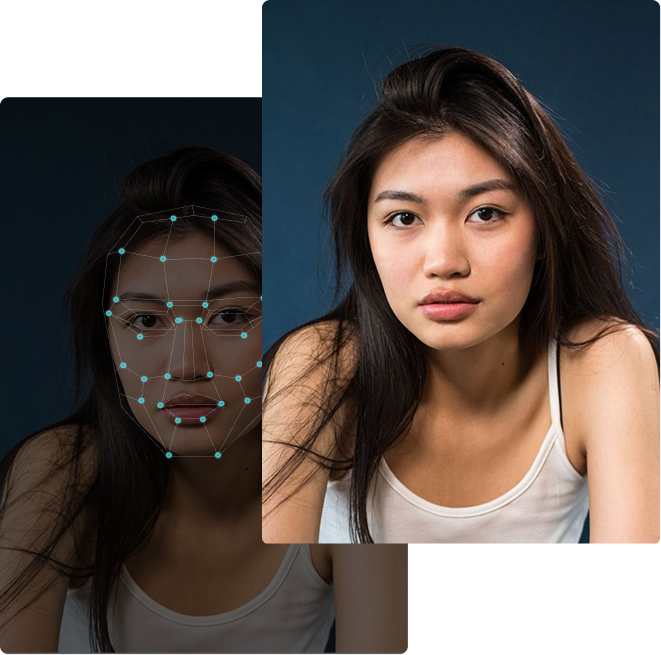
A synthetic person is a human figure in a video that was generated by an AI model rather than captured by a camera. The face, the body, the motion, and increasingly the voice are all produced from a text description or a reference image. No real person stood in front of a lens.
This is different from a traditional deepfake, which usually swaps or alters footage of a real individual. Text-to-video synthetic people can be invented from nothing, or they can be steered to resemble a target. Either way the underlying machinery is the same: a model that has learned what humans look like in motion from millions of training clips, then reconstructs that pattern on demand.
The realism has moved fast. Writing in Fortune at the end of 2025, deepfake researcher Siwei Lyu noted that for everyday scenarios such as low-resolution video calls and social clips, synthetic human media is now realistic enough to reliably fool ordinary viewers, and in some cases institutions. For anyone running identity verification, that turns a research curiosity into an operational problem.
How Text-to-Video AI Generates Synthetic People: The Pipeline
Almost every leading text-to-video model in 2026, including OpenAI's Sora, Google's Veo, and Kuaishou's Kling, shares the same backbone: a diffusion transformer working in a compressed latent space. The 2023 research paper that introduced the diffusion transformer, by William Peebles and Saining Xie, replaced the older U-Net design and is the architectural ancestor of nearly every serious video model shipping today.
The process runs in five broad stages. The table below summarizes them, and the sections that follow walk through each one.
From a sentence to a person who never existed
Sora, Veo and Kling share one backbone: a diffusion transformer denoising random static in a compressed latent space. No camera, no anatomy, the person is assembled from statistics, in five stages.
The model has no skeleton and no 3D head. The face is a statistical average of training faces, plausible, but with no fixed anatomy underneath. That gap is exactly what the artifacts come from.
Table 1: The five stages a text-to-video model runs through to turn a sentence into a synthetic person.
Step 1: Turning words into numbers
The prompt is first read by a text encoder, which converts the sentence into a set of numerical embeddings. This is where the model decides that a phrase like a woman in her forties speaking to a webcam refers to a person, fixes her approximate age and setting, and captures stylistic cues such as lighting and camera angle. These embeddings do not contain a face. They contain instructions that will steer the rest of the pipeline toward one.
Step 2: Compressing video into a latent space
Generating video directly in pixels is enormously expensive, so models do not work in pixels at all during the heavy lifting. A component called a variational autoencoder, or VAE, compresses video into a much smaller spatiotemporal grid. The compression is aggressive. The LTX-Video model, for example, squeezes video at a ratio of 192 to 1, representing a block of 32 by 32 pixels across 8 frames as a single token.
This matters for a reason that is easy to miss: the model never reasons about a real human face. It works on a compressed code that stands in for one. Bone structure, anatomy, and the way a specific person's skin catches light are not represented as such. They are statistical regularities baked into the latent space.
Step 3: Denoising with a diffusion transformer
Now the generation begins. The model starts with a field of random noise in the latent space and removes that noise in steps, each step guided by the text embeddings through a mechanism called cross-attention. Over many steps, structure emerges from the static and a coherent scene takes shape.
This is the stage where the synthetic person actually forms. Because the face is assembled by averaging across everything the model learned about human faces, it tends to look plausible rather than specific. It is a convincing human, but one with no birth certificate, no fixed identity, and no skeleton underneath.
Step 4: Holding the person together across time
A still image only has to be coherent in space. A video has to be coherent across time as well, so that the person in frame 200 is recognizably the same one from frame 1. Models achieve this with temporal attention layers and three-dimensional convolutions that let frames relate to one another rather than being generated in isolation. Sora's approach treats video as a sequence of spacetime patches and applies attention across both space and time at once.
When this temporal binding is weak, you get the flicker and identity drift covered later. When it is strong, the synthetic person stays stable, blinks at roughly the right cadence, and turns their head without their features rearranging.
Step 5: Decoding back to pixels
Finally, the VAE decoder converts the finished latent back into viewable frames. Fine detail that was lost during compression, such as skin pores and individual hairs, is rebuilt here. This is also where over-smoothing tends to creep in, leaving the waxy, poreless skin that many viewers recognize without being able to name.
Why Synthetic Faces Are Harder Than They Look
A useful way to understand the limits of synthetic people is to remember what the model does not have. It has no three-dimensional model of the head. It has no muscles, no jaw hinge, no understanding that a blink is a reflex on a roughly five-second cycle. Everything it produces is a prediction of what pixels usually follow other pixels, learned from video.
That works well for the easy parts and fails on the parts that need a physical model of the world. Hands are the classic example. They rotate, overlap, and grip objects, and the model has only seen flat projections of that complexity, so it frequently produces extra fingers, fused fingers, or digits that bend the wrong way. Specialized human animation systems get around this by adding explicit structure, conditioning the diffusion process on a pose skeleton or a parametric face model such as FLAME, but general text-to-video tools usually have no such scaffolding.
The same gap explains why identity is fragile. With no fixed reference for the person, the model can only try to keep the face self-consistent through temporal attention. Over a long clip, small errors accumulate and the face can slowly drift into a different one.
The Artifacts That Still Give Synthetic People Away
Synthetic humans have improved to the point where casual inspection is unreliable. Studies of human performance put it near 50 percent, which is close to guessing. Still, current models leave systematic traces, and knowing where to look helps. The table below maps the most common artifacts to the reason the model produces each one.
Six artifacts, and the two that actually hold up
Casual inspection is near a coin flip against good models. The spatial tells (hands, skin) get fixed generation by generation; the temporal ones, how a face behaves across frames, are far harder to fake.
A single frame can look flawless. The durable signal is temporal, continuity, motion physics and face consistency across frames, which is why detection now reads whole clips, not stills, and doesn't need to know which model made the video.
Table 2: Common artifacts in AI-generated synthetic people and the part of the pipeline that causes each.
Two points are worth stressing. First, these are tells, not proofs. A high-quality clip from a frontier model may show none of them on casual viewing. Second, the most durable signals are temporal rather than spatial. A single frame can look flawless, but the relationships between frames, the physics of motion, and the consistency of a face over time are far harder to fake. This is why modern detection has shifted away from inspecting individual frames toward analyzing whole clips for continuity and physics violations, an approach that does not need to know which model produced the video.
From Generated Clip to Fraud Attack
For an identity verification team, the interesting question is not how a synthetic person is made but how it arrives. A generated clip is harmless until it is pointed at a system that treats video as evidence of a real, present human.
There are a handful of common delivery routes. The 2026 Identity Fraud Report from Entrust found that deepfake selfies rose by 58 percent in 2025, and much of that volume targets onboarding flows that ask a user to take a live selfie. The table below outlines the main vectors.
Table 3: How a synthetic person reaches an identity verification system.
The through line is that the synthetic person is rarely the whole attack. It is one component, usually paired with a delivery trick such as a virtual camera that presents the generated stream to the operating system as though it came from a physical webcam. Detecting the synthetic media itself is necessary but not sufficient. This is the layer where DeepDetector focuses, flagging AI-generated and manipulated video before it is accepted as a genuine capture. For a closer look at how these delivery tricks differ, see our breakdown of presentation attacks versus injection attacks.
Common Misconceptions About Spotting Synthetic People
If the hands look fine, the video is real
Hands were the signature flaw of early models, and many have largely fixed them. Treating clean hands as a clearance check means waving through every clip that cleared that one bar. The relevant tells now sit in motion and time, not in any single body part.
A detector that scored well in a demo will score well in production
Detection accuracy measured on clean academic datasets tends to drop on real-world footage that has been compressed, re-encoded, and screen-recorded. The DeepFake-Eval-2024 study found that commercial detectors scored around 78 percent on in-the-wild content, well below their lab numbers. Plan for that gap rather than the brochure figure.
Liveness checks already handle this
Passive liveness alone is increasingly bypassed by injected synthetic streams. Active liveness and explicit injection-attack detection close part of that hole, but neither is a substitute for analyzing whether the media itself is generated.
Staff can catch the obvious ones
Human reviewers perform barely better than chance against high-quality synthetic media, and they get worse under time pressure. The reliable signal comes from forensic analysis, not from a trained eye.
Practical Recommendations
- Treat video as untrusted input. Any flow that accepts a selfie, a liveness clip, or a video call should assume the stream could be synthetic or injected, and verify accordingly.
- Detect at the media layer and the delivery layer. Combine analysis of whether the content is AI-generated with checks for virtual cameras and injection.
- Prefer temporal detection. Frame-by-frame inspection misses what cross-frame and physics analysis catches. See how deepfake detection works for the underlying methods.
- Benchmark on your own traffic. Lab accuracy does not transfer. Test detectors on compressed, real-world footage that resembles what your pipeline actually sees, using the kind of volume context in our deepfake statistics roundup.
- Prepare for disclosure rules. From 2 August 2026, Article 50 of the EU AI Act requires that deepfake content be clearly labeled, with penalties for non-compliance.
DeepDetector is built for the first three of those. It analyzes video and image content for the signatures of synthetic generation and manipulation, including the temporal inconsistencies that survive compression and that the human eye cannot reliably catch.
Frequently Asked Questions
How does text-to-video AI create a realistic human face?
It does not draw a face from anatomy. A diffusion transformer starts with random noise in a compressed latent space and removes it step by step, guided by your text prompt, until a face emerges as a statistical blend of the human faces in its training data. A VAE then decodes that result into pixels.
Why do AI-generated people often have strange hands?
Hands are geometrically complex. They rotate, overlap, and grip objects, and the model learned them only from flat video, with no underlying skeleton. That makes extra fingers, fused fingers, and impossible joints one of the most persistent artifacts, especially during motion.
Can text-to-video AI generate a specific real person?
General models tend to produce invented people unless they are steered with reference images or fine-tuned on a target. When they are conditioned that way, the output crosses into deepfake territory, impersonating a real individual rather than inventing one.
How can you tell if a video of a person is AI-generated?
Casual viewing is no longer reliable. Useful tells include unnatural blinking, waxy skin, flickering backgrounds, physics errors in hair or clothing, and identity drift across a clip. The most dependable signals are temporal: continuity and motion physics across frames rather than any single image.
What is the difference between a deepfake and a text-to-video synthetic person?
A traditional deepfake manipulates footage of a real person, often by swapping a face. A text-to-video synthetic person can be generated entirely from a prompt, with no source footage. The terms overlap when a generated person is deliberately made to resemble a real target.
Are synthetic people a threat to identity verification?
Yes. Generated faces are used in synthetic selfies, real-time face swaps, and replayed clips, often injected through a virtual camera. Entrust reported a 58 percent rise in deepfake selfies in 2025, much of it aimed at onboarding and liveness checks.
Why do AI-generated faces flicker or change during a video?
Because the model regenerates content frame by frame and is not anchored to a fixed 3D model of the person. Temporal attention reduces this, but when it is weak, static regions shimmer and the face can slowly drift into a different one over a long clip.

About the author