













.webp)


Most people think of deepfakes as a final product: a video, a voice clip, a manipulated image. What they rarely consider is the machinery running before, during, and after that content is created. Every deepfake app, from the polished consumer tools to the underground DaaS platforms, executes a sequence of data operations that most users never see and never agreed to. Understanding those operations is no longer optional. As deepfake fraud losses in the U.S. alone exceeded $1.1 billion in 2025 (Proofpoint), and the total volume of online deepfakes grew from roughly 500,000 in 2023 to an estimated 8 million by that same year (DeepStrike), the infrastructure powering these tools has become a serious concern for security teams, identity verification providers, and regulators alike.
This guide breaks down the full technical pipeline of deepfake generation, from the moment a user uploads a photo to the moment a synthetic face appears onscreen. It also examines what happens to the data submitted to these apps and why the hidden back-end operations carry risks that extend well beyond the obvious.
- Deepfake apps extract biometric data including facial geometry maps and voice embeddings during normal use, often without clear disclosure to users.
- GAN-based face swap, diffusion model synthesis, and real-time voice conversion operate through distinct but analogous pipelines, each leaving characteristic detection artifacts.
- Voice cloning requires as little as 3 seconds of audio to produce an 85% voice match, lowering the barrier to live-call impersonation attacks significantly.
- Uploaded photos are frequently retained for model training under vague service improvement language, meaning the biometric extraction has already occurred even if the source file is later deleted.
- Human ability to detect deepfake video stands at approximately 24.5%, near random performance, while 60% of people believe they can spot a deepfake reliably.
- Automated multimodal detection systems that cross-reference audio, video, and metadata signals significantly outperform single-modality approaches and human reviewers.
- AI-powered deepfakes were involved in more than 30% of high-impact corporate impersonation attacks in 2025, making this a mainstream enterprise threat rather than a niche concern.
Deepfake apps have gone mainstream, and so has the fraud they enable. The volume is exploding, the losses are real, and the biggest weakness is misplaced confidence, people think they can spot fakes, but can't.
What Is a Deepfake App?
A deepfake app is any software that uses artificial intelligence to synthesize or manipulate a person's face, body, or voice in ways that are difficult or impossible to distinguish from authentic media. The term combines "deep learning" and "fake," reflecting the foundational technology underneath. While early deepfake tools required significant machine learning expertise and specialized hardware, today's applications have abstracted that complexity almost entirely. A user uploads a photo or short video clip and receives a convincing synthetic output within seconds.
That simplicity on the surface masks a multi-stage process underneath. Modern deepfake apps are built on three primary AI architectures: Generative Adversarial Networks (GANs), diffusion models, and neural codec models for audio. Each handles different manipulation types and operates through a pipeline with distinct stages, each of which has its own data and privacy implications.
What runs between "upload" and the result
A deepfake app looks like one step: upload a photo, get a clip. Underneath, it runs four stages, and the user only ever sees the first and the last. The two in the middle, plus what happens afterward, are where the real exposure is.
By stage 1 your face is already biometric data (GDPR Art. 9). Deleting the photo later doesn't undo it, the encoding was extracted the moment you uploaded.
Stage 1: Data Ingestion and Preprocessing
Before any generation happens, the app must extract usable information from what the user uploaded.
Face Detection and Landmark Extraction
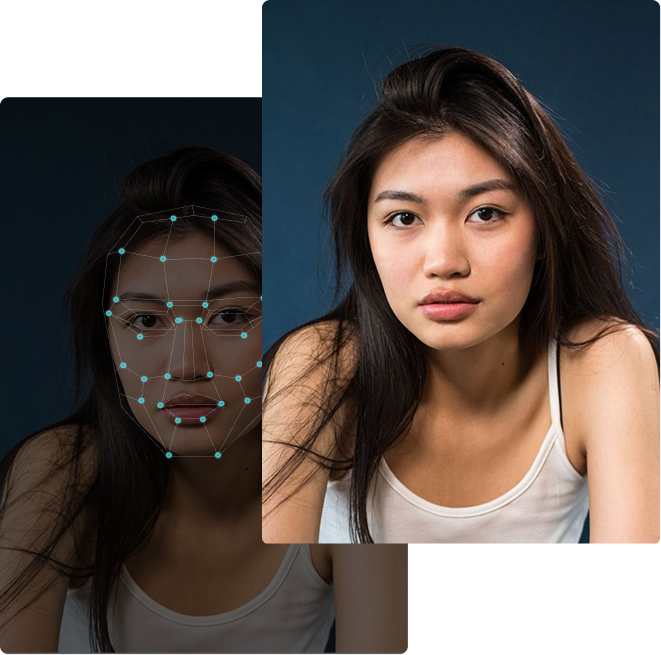
When a user submits a photo or video, the app's first step is face detection. A neural network locates all faces in the frame, identifies 68 to 468 facial landmarks depending on the model used, and builds a geometric map of the face. These landmarks correspond to the corners of the eyes, the edges of the lips, the tip of the nose, the jawline curve, and dozens of other anatomical reference points.
This extraction step is not merely a visual convenience. The geometric map produced here constitutes biometric data under GDPR Article 9, CCPA, and equivalent frameworks in most major jurisdictions. Under GDPR, biometric data receives special category protections, requiring explicit consent or a narrow legitimate interest basis for processing. Most consumer deepfake apps do not obtain this consent explicitly, and many process this data without users understanding its legal classification.
Encoding into Latent Space
Once landmarks are extracted, the face is encoded into what AI researchers call latent space. A neural encoder compresses the raw pixel data into a compact mathematical representation, a vector that captures the identity characteristics of that face: its proportions, texture, depth information, and expression parameters.
This encoding step is the core intelligence of the system. The latent representation is what gets transferred, manipulated, or recombined when the deepfake is generated. It is also the data point with the highest value to attackers: a face encoding can be used to reconstruct an approximate likeness, to power a face-swap engine, or to train a new model targeting that identity.
Stage 2: The Generation Engine
The generation stage is where the actual synthesis happens. The specific mechanism depends on the application type.
GAN-Based Face Swaps
Generative Adversarial Networks remain the dominant architecture for face-swap deepfakes. A GAN consists of two competing neural networks: a generator that creates synthetic images and a discriminator that tries to determine whether an image is real or generated. The two networks train against each other, with the generator progressively improving until it produces outputs that reliably fool the discriminator.
For face swapping specifically, GAN-based systems accomplish three simultaneous tasks: transplanting the source face's identity onto the target video's pose and expression, matching lighting conditions between source and target, and blending the edges of the swapped face seamlessly with the surrounding hair and neck region. Modern implementations use architectures such as StarGAN and CycleGAN to handle cross-domain transfers, including changes in age, lighting, and skin tone that would previously have produced visible artifacts.
Diffusion Model Generation
Newer deepfake apps increasingly rely on diffusion models rather than GANs. Where GANs learn through competition, diffusion models learn by progressively adding and then removing noise from training images. The result is a generation process that tends to produce higher-fidelity outputs with fewer of the boundary artifacts and flickering that characterized early GAN deepfakes.
Platforms built on Stable Diffusion and similar architectures can generate full synthetic identities from text prompts, condition output on a reference face, or perform inpainting operations that replace specific facial regions while preserving the surrounding context. Video generation models from providers such as OpenAI's Sora 2 and Google's Veo 3 extend this capability into temporally consistent video, maintaining a stable synthetic identity across frames.
Audio: Voice Cloning Pipeline
Voice deepfakes use a different but analogous pipeline. The audio processing chain has two variants: text-to-speech synthesis, where text is converted into speech in the cloned voice, and voice conversion, where a live or pre-recorded audio stream is transformed into the target speaker's voice in near real time.
Both variants begin with speaker embedding extraction. The model analyzes the submitted audio sample, which can be as short as 3 seconds according to McAfee research, extracting acoustic features that define the speaker's unique vocal characteristics: fundamental frequency, formant patterns, speaking rhythm, and prosodic contour. These features are compressed into a speaker embedding vector analogous to the face encoding described earlier.
In the text-to-speech path, a TTS acoustic model conditioned on this speaker embedding converts text input into mel-spectrograms, which a vocoder then converts into a waveform. In the voice conversion path, the attacker speaks, and the system strips the acoustic identity from their voice while substituting the target's embedded characteristics in real time, allowing a two-way conversation that sounds like the target.
Table 1: Core deepfake generation architectures, their primary fraud applications, minimum source data requirements, real-time capability, and characteristic detection artifacts. Sources: SoftwareSeni (2026), McAfee Research, Xenonstack.
Stage 3: Post-Processing and Output Rendering
Raw generation output is rarely the final product. Most deepfake apps run the synthetic output through a post-processing pipeline before delivering it to the user.
Blending and Color Correction
Face-swap outputs require post-processing to integrate the generated face with the original video frame. This involves Poisson image blending to smooth color gradients at face boundaries, histogram matching to align the color temperature of the source face with the ambient lighting in the target scene, and sharpening passes to restore fine-grained texture detail that generation may have softened.
Apps also apply temporal consistency filters to video output. Frame-by-frame generation can produce subtle variations in the synthetic face that read as flickering to a viewer or, critically, as statistical anomalies to detection systems. Temporal smoothing layers average feature values across adjacent frames, making the output harder to flag at the individual-frame level.
Resolution Upscaling
Many mobile deepfake apps accept low-resolution source photos and deliver high-resolution outputs. This upscaling is accomplished through super-resolution neural networks that reconstruct plausible high-frequency detail from low-resolution inputs. The practical implication is that a social media profile photo can serve as sufficient source material for a convincing high-resolution deepfake, eliminating the previous requirement for high-quality source imagery.
Stage 4: What Happens to Your Data
This is the stage most users never consider, and it is where the risks extend beyond the synthetic output itself.
Where your face goes after you upload it
The output is only one use of your upload. The face encoding extracted in preprocessing is the high-value asset, and under broad "service improvement" terms it can fan out in four directions you never see.
It isn't only your own face. Any photo with other people processes their biometrics too, the Grok incident reportedly handled 160,000+ biometric instances a day from people who never used it.
Data Retention and Model Training
When a user uploads a photo or video to a deepfake app, that upload typically does more than produce one output. Many consumer deepfake platforms retain uploaded biometric data for uses described vaguely in their terms of service. Phrases like "improve our services," "enhance user experience," or "train our models" can legally justify almost any downstream use of submitted facial data.
The acquired face data may be used to retrain the generation model, expanding its capability to handle new demographics or lighting conditions. It may be stored in a facial database for future lookups. Or it may be sold to third parties operating under the same broad consent framework. Notably, acquired face data need not even be used for deepfake generation to create significant privacy risk: biometric data stored in these systems constitutes an attack surface regardless of its intended use.
Biometric Data Classification
Every photo submitted to a face-swap app that performs facial landmark extraction is being processed as biometric data under most modern privacy frameworks. The individual whose face appears in that photo has generated a biometric identifier they cannot revoke from the app's servers after the fact. Under GDPR, the right to erasure exists in principle, but enforcement has proven difficult at scale.
The Grok deepfake incident of early 2026 illustrated this exposure concretely. Researchers estimated the platform processed over 160,000 instances of biometric data daily, representing faces of individuals who never interacted with the platform and who had no mechanism to object to or remove that processing.
Server Location and Regulatory Reach
Many of the most widely downloaded deepfake apps operate from jurisdictions with limited data protection infrastructure. User photos submitted from the European Union or California may be stored on servers in countries where GDPR and CCPA have no direct enforcement authority. This geographic fragmentation of data storage is a deliberate architecture choice: it insulates platforms from the strongest regional privacy regimes while maintaining access to those regions' user bases.
Table 2: Data operations performed by consumer deepfake applications, their regulatory classification, typical disclosure level, and associated risk. Sources: Infosecurity Magazine, LumenXo Research (2025), Captain Compliance (2026), GDPR Article 9.
The Artifacts Deepfakes Leave Behind
Understanding how deepfakes are generated also illuminates how they can be detected. The same pipeline that produces the synthetic output introduces statistical artifacts that detection systems can identify.
Frequency-Domain Fingerprints
GAN and diffusion models leave subtle traces in the frequency domain of their output that are not visible to the human eye but are measurable through Fourier transform analysis. High-frequency components in authentic photographs follow natural photographic physics; GAN-generated images show characteristic spectral patterns linked to upsampling artifacts in the generator architecture. Detection systems that apply wavelet transforms or similar frequency-aware methods can expose these patterns even after JPEG compression has obscured them in the spatial domain.
Physiological Inconsistencies
Human faces in authentic video exhibit dozens of subtle physiological signals: pupillary dilation, skin color variation tied to blood flow, micro-expressions that precede conscious facial movement, and blinking patterns correlated with cognitive load. Deepfake generation models optimize for visible realism but do not model these sub-perceptual signals accurately. Detection systems trained on physiological pattern analysis can identify inconsistencies in blink rates, unnatural absence of micro-expressions, and lip-sync mismatches where phoneme timing in the audio does not correspond precisely to visible articulatory movement.
Boundary and Temporal Artifacts
Face-blending operations leave statistical residues at the boundary between the synthetic face and the original frame. Even when invisible to a human reviewer, the pixel distribution at these boundaries follows different statistical properties than the surrounding image. Temporal artifacts arise when per-frame processing introduces subtle variations in face geometry or color that produce statistical discontinuities between adjacent frames, a signature that multimodal detectors flag through cross-frame analysis.
Automated detection systems analyze these artifacts across multiple modalities simultaneously, cross-referencing audio, video, and metadata signals rather than relying on any single indicator. This is the approach best suited to modern deepfakes that have been optimized to defeat single-modality detectors.
Table 3: Primary automated detection methods for deepfake content, what each analyzes, which generation methods it targets, and known limitations. Sources: Mixflow.ai (2025), SoftwareSeni (2026), Sider.ai Deepfake Detection Guide (2025).
Common Misconceptions About Deepfake Apps
"I can tell a deepfake by looking." Human detection accuracy for deepfake video is approximately 24.5%, roughly one in four, according to DeepStrike research. A 2025 iProov study found that only 0.1% of participants correctly identified all fake and real media they were shown. Approximately 60% of people believe they can spot a deepfake, while actual performance is near random. The confidence-accuracy gap is what makes deepfake social engineering so effective.
"The app deletes my photo after processing." Some apps do delete uploaded files after analysis, and reputable privacy-forward services publish clear policies stating as much. However, most consumer entertainment deepfake apps retain uploaded data beyond the processing window, and the biometric embeddings extracted during preprocessing may persist in model training pipelines even if the original file is eventually deleted. The extraction has already occurred; deleting the source file does not undo it.
"Only celebrities get deepfaked." The shift toward Deepfake-as-a-Service platforms has made targeted deepfakes accessible to anyone with a subscription. Finance employees, compliance officers, enterprise executives, and ordinary individuals are now primary targets. According to Cyble's 2025 Executive Threat Monitoring report, AI-powered deepfakes were involved in more than 30% of high-impact corporate impersonation attacks that year.
"Watermarks make deepfakes identifiable." Content authenticity watermarks, including implementations based on the C2PA standard, are a meaningful step forward but are not a complete solution. Watermarks can be stripped during re-encoding, JPEG recompression, or screen recording. They also only apply to content generated by compliant platforms. Underground DaaS tools have no watermarking infrastructure and are not subject to voluntary disclosure standards.
Practical Recommendations
For security teams: Treat video and audio calls as unverified channels. Establish out-of-band verification procedures for any request involving financial authorization, credential access, or policy exceptions, regardless of how convincing the caller appears. Real-time voice conversion technology has advanced to the point where live-call impersonation is a credible attack vector in 2026.
For identity verification providers: Static liveness detection that relies solely on visual inspection is insufficient against modern face-swap attacks. Effective deepfake-resistant liveness verification combines active challenge-response with passive physiological signal analysis and frequency-domain artifact detection. The attack surface has expanded; the detection pipeline must expand accordingly.
For platform operators: Before deploying any third-party AI image or video processing component, review its data retention policies at the contractual level, not just the terms-of-service summary. Understand where uploaded biometric data is stored, how long it is retained, whether it is used for model training, and what deletion mechanisms exist. The GDPR Data Protection Impact Assessment requirement exists precisely for processing activities of this type.
For individual users: If an app's privacy policy uses broad language around "service improvement" or "model enhancement" without specifying what that entails, assume your uploaded biometric data will be retained and used for training. Consider whether the output is worth that exchange. For any photo upload that includes other identifiable individuals, note that their biometric data is being processed without their knowledge or consent.
FAQ
What is the most common deepfake generation method in 2026? GAN-based face swapping remains widely used for real-time and video deepfakes, but diffusion model approaches are increasingly common for high-quality image synthesis. Voice deepfakes rely primarily on neural codec models with speaker embedding extraction, which can produce convincing clones from as little as 3 seconds of audio.
How much audio or video is needed to create a convincing deepfake? For voice cloning, McAfee research found 3 seconds of audio produces an 85% voice match, with ThreatLocker putting high-fidelity cloning at 30 seconds. For visual deepfakes, current super-resolution architectures mean that a single high-resolution social media photo can serve as adequate source material for many generation models.
Do deepfake apps really retain uploaded photos? Reputable analysis tools that detect deepfakes typically delete uploads immediately after processing. Consumer entertainment apps that generate deepfakes have inconsistent policies: many retain uploaded biometric data for model training purposes, with disclosure buried in broad service improvement language in their terms of service.
What does "biometric data" mean in the context of deepfake apps? Any photo or video processed through facial landmark extraction constitutes biometric data under GDPR Article 9, the California CCPA, and most modern privacy frameworks, because the resulting face encoding uniquely identifies a natural person. This classification triggers special category protections, including requirements for explicit consent before processing.
Can real-time deepfake calls be detected? Yes, though it is technically difficult. Real-time voice conversion and video deepfakes introduce detectable artifacts in frequency-domain analysis, physiological signal patterns, and audio-visual synchronization. Automated systems analyzing multiple data streams simultaneously are more reliable than human reviewers, who detect deepfake audio at approximately 48% accuracy, near coin-flip odds.
What is Deepfake-as-a-Service (DaaS)? DaaS refers to subscription-based platforms that provide ready-to-use AI tools for voice cloning, video generation, and persona simulation without requiring technical expertise. These platforms became widely available in 2025 and were involved in more than 30% of high-impact corporate impersonation attacks that year according to Cyble, enabling fraud at scale against organizations with otherwise strong security controls.
How do detection systems identify deepfake artifacts? Modern detection systems analyze artifacts across multiple dimensions: frequency-domain spectral patterns introduced by upsampling in GAN generators, physiological signals such as blinking rates and micro-expression timing that generative models do not replicate accurately, lip-sync consistency between audio phonemes and visible articulation, and boundary statistics at the face-frame blending region. Multimodal detectors that cross-reference these signals outperform single-modality approaches and human reviewers.

About the author