












.webp)


A face-swap deepfake replaces one person's face with another's in an image or video by training a neural network to compress a face into a compact mathematical representation, then reconstruct a different identity from it, frame by frame, with the original lighting, pose, and expression preserved. The technique that started as an anonymous Reddit project in 2017 is now the single most common method fraudsters use to defeat remote identity verification. According to Sumsub's 2025-2026 Identity Fraud Report, deepfakes accounted for 11% of all identity fraud globally in 2025.
This guide is for security leads, compliance officers, and product teams at identity verification (IDV) and fintech companies who need to understand the mechanics, not the marketing, of how these attacks are built, how they have evolved across three generations of AI architecture, and where the seams that detection systems exploit actually are. No deep learning background required.
- A face swap transfers a source identity onto a target's face region while keeping the target's expression and pose, distinct from face reenactment and from fully synthetic faces.
- Every method runs the same four-stage pipeline: detect and landmark, align and crop, encode and swap, then blend and post-process.
- Three generations of models exist: per-pair autoencoders (2017), one-shot GANs with ID injection (2020), and diffusion models (2023+).
- Modern one-shot tools need only a single source image, so a scraped headshot is enough raw material.
- Injection attacks feed the fake through a virtual camera, bypassing the lens and defeating the core assumption behind remote IDV.
- Real-time face swap is sold as fraud-as-a-service for under $50/month; a usable AI face costs about $20.
- Detection uses four signal families: blending boundary, frequency domain, temporal consistency, and identity vectors.
- Generalization, not benchmark accuracy, is the metric that predicts production performance.
Face swapping is now cheap, fast, and needs almost nothing, a single scraped photo and a monthly subscription. That accessibility is why it's the most common method fraudsters use to defeat remote identity verification.
What Is a Face-Swap Deepfake?
A face-swap deepfake transfers the identity of a source person onto the face region of a target person while keeping the target's expression, head pose, and orientation intact. In a swapped video of you, the face belongs to someone else, but the blinking, the head tilt, and the way the mouth moves to speak are still yours. This is what separates face swapping from its close cousin, face reenactment, which keeps the original identity but transfers new expressions onto it, effectively puppeteering a real face.
It also differs from a fully synthetic face, which is generated from scratch by a model like StyleGAN and corresponds to no real human. A face swap is a composite: it stitches a generated face region into an otherwise real frame. That compositing step matters, because it is exactly where the most reliable detection signals are left behind.
The term contracts "deep learning" and "fake," and traces back to a Reddit account in 2017 that released the first autoencoder-based face-swapping code. Two open-source forks, FaceSwap and DeepFaceLab, turned it into the tools still in wide use today, each with tens of thousands of GitHub stars, per academic surveys of the technique (FakeTracer, 2023).
How a Face-Swap Deepfake Is Built: The Four-Stage Pipeline
Every face-swap method, regardless of the underlying AI architecture, runs some version of the same four-stage pipeline. Understanding these stages is the fastest way to understand both how the fakes are made and why they can be caught.
Every face swap runs the same four stages
Whatever model is underneath, the pipeline is the same: find the face, normalise it, swap the identity, then blend it back into the real frame. Knowing the stages is the fastest way to see both how fakes are made and where they're caught.
For video, all four stages run again on every single frame, that independent, per-frame processing is exactly what makes swaps flicker between frames.
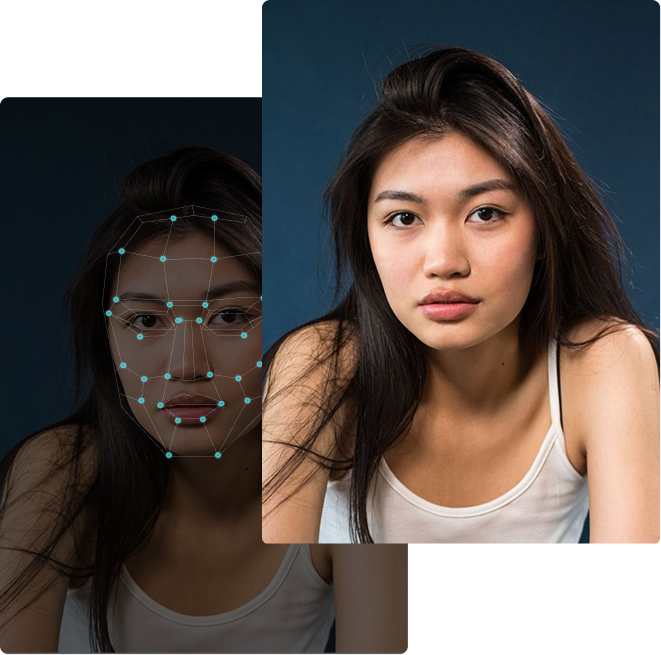
1. Detect and locate the face. The pipeline first runs a face detector over each frame, then extracts facial landmarks, keypoints marking the eyes, nose, mouth, and jaw, that anchor everything that follows (Landmark Breaker, 2021).
2. Align and crop. Using those landmarks, the face is rotated, scaled, and warped to a standard, front-facing configuration, then cropped. Neural networks learn far more efficiently when every face sits in roughly the same position and size.
3. Encode and swap. The aligned face enters the trained model. An encoder compresses it into a low-dimensional latent representation, stripping identity but preserving expression, and a decoder reconstructs a face. The trick is that the decoder belongs to a different identity, so it paints a new face onto the original expression.
4. Blend and post-process. Because the model generates only the inner face region, the result is merged back into the real frame: color correction matches skin tone, brightness and contrast match the lighting, and the mask edges are feathered to hide the seam, often with Poisson image editing (AI Summer).
For video, stages one through four repeat for every frame. That per-frame, independent processing is the source of one of the most useful detection signals.
The Three Generations of Face-Swap Models
The "encode and swap" stage has gone through three architectural generations. Each solved the previous generation's biggest limitation, and each left a different fingerprint.
Generation 1: Autoencoders (one model per identity pair)
The original 2017 approach trains two autoencoders that share a single encoder but have separate decoders. The shared encoder learns a general "language" for faces; each decoder learns one specific person. To swap, you feed a frame of person A through the shared encoder and then through person B's decoder (head-pose study, 2021). The catch: you need hundreds or thousands of images of both people, training takes hours to days, and the model only works for that one pair. This is the architecture behind DeepFaceLab and FaceSwap.
Generation 2: GAN-based, one-shot swapping (ID injection)
In 2020, SimSwap introduced the breakthrough that defines most modern tools: instead of training a model per identity, it extracts the source person's identity as a feature vector and injects it into a generic encoder-decoder (SimSwap review, 2025). One model now works for any face pair from a single source image. GANs train a generator and a discriminator in tandem; inference is one forward pass, fast enough for real time. Tools in this lineage, including InSwapper, FaceShifter, and DeepFaceLive, democratized swapping to one photo and a few seconds (InsightFace). The tradeoff is texture inconsistency and identity bleeding when faces differ a lot in shape (WaveSpeed, 2026).
Generation 3: Diffusion models (high fidelity, high cost)
The newest generation, beginning with DiffSwap (CVPR 2023), reframes face swapping as a conditional inpainting problem solved by diffusion models. Diffusion offers more stable training and better fidelity than GANs, but multi-step denoising means inference takes seconds, not milliseconds, which currently disqualifies pure diffusion from live, real-time attacks (WaveSpeed, 2026).
Table 1: The three architectural generations of face-swap models, by data requirement and speed.
The practical takeaway: the architecture an attacker chooses is a tradeoff between quality and speed. An asynchronous KYC check can be attacked with slow, high-fidelity diffusion; a live video call has to use a fast GAN-based tool. That constraint shapes which attacks show up where.
From Recorded Clips to Live Attacks: Presentation vs. Injection
For an IDV pipeline, how a face swap reaches the verification system matters as much as how it was made. A presentation attack shows the fake to the real camera, for example by replaying a deepfake on a second screen. An injection attack skips the camera entirely: using a virtual camera driver that impersonates a webcam, the attacker feeds a synthetic stream directly into the verification app, which receives it as if it came from a physical sensor (Facia, 2026).
Shown to the camera, or fed straight past it
For an IDV pipeline, how a swap is delivered matters as much as how it's made. One attack still goes through the lens. The other skips the camera entirely, which is what makes it so dangerous.
Injection defeats the assumption every remote IDV system was built on, that the webcam feed is real. Stopping it needs dedicated injection-attack detection: device attestation, stream integrity and frame-level consistency, on top of liveness.
Table 2: The two delivery mechanisms for a face-swap deepfake against an IDV pipeline.
Injection is the more dangerous mechanism because it defeats the assumption every remote IDV system was built on: that the face on the webcam matches the person in front of it. Consumer tools like DeepFaceLive now perform frame-by-frame replacement on a standard laptop with latency low enough to pass real-time interaction, blinking, turning, and smiling on prompt (Truescreen, 2026). In a documented red-team scenario added to the MITRE ATLAS knowledge base, biometric firm iProov's team used off-the-shelf face-swap and virtual-camera software to pass liveness checks under a false identity (SecurityBrief, 2026).
The economics make this a volume problem. Real-time face swap, camera injection, and voice cloning are sold as fraud-as-a-service for under $50 a month, and a usable AI-generated face costs roughly $20. For a deeper breakdown of these two attack classes, see our analysis of presentation attacks vs. injection attacks.
How Face-Swap Deepfakes Are Detected
Detection works by finding the traces the four-stage pipeline cannot fully erase. There are four major families of signal, and robust systems combine several rather than relying on one.
Blending-boundary artifacts. Because a swap renders only the inner face region and merges it into a real frame, the seam carries inconsistencies in color, texture, and resolution. The Face X-ray method detects deepfakes by predicting this boundary, and detectors trained on "self-blended images" generalize unusually well to unseen methods (eKYC detection, 2025).
Frequency-domain artifacts. Generative models leave statistical fingerprints in the high-frequency components of an image, invisible to the eye but visible under transforms like the Discrete Cosine Transform (Nature, 2025).
Temporal inconsistencies. Because video swaps are produced frame by frame, they flicker and stutter, showing unnatural blink frequency, lip-sync errors, and jitter at the face boundary, in ways genuine footage does not (IET survey, 2025).
Identity-vector analysis. Face-recognition embeddings can flag when the identity in a frame is inconsistent with itself across time or with a reference image, an approach that performs especially well against face swapping.
Table 3: The four families of signal used to detect face-swap deepfakes.
This is where the lab-to-production gap bites. A detector that scores well on a benchmark of known manipulations can fail against a novel tool or a heavily compressed stream, which is why generalization, not headline accuracy, is the metric that matters. DuckDuckGoose's DeepDetector is built around explainable, generalizable models that not only classify media as manipulated but also produce a visual activation map showing which region drove the decision. For why benchmark numbers mislead, see our breakdown of deepfake detection accuracy.
Common Misconceptions
"Liveness detection stops face swaps." Passive liveness only confirms that a frame looks like a live human face, which a good swap satisfies. And no liveness check that trusts the camera can stop an injection attack, because the fake never passes through a lens.
"The human eye can catch them." Reviewers caught early swaps with mismatched skin tone and warped edges. Generation 2 and 3 tools have closed most visible gaps; the surviving artifacts are largely sub-perceptual.
"High benchmark accuracy means production-ready." Accuracy on a curated dataset says little about an unseen tool, an adversarial example, or a compressed live stream.
"It's only a video problem." The same identity-injection techniques also forge the selfie and document images in asynchronous onboarding. Image-only flows are not exempt.
"More training data always means a better fake." True for Generation 1, but one-shot tools need only a single source image, which is why a scraped headshot is now enough.
Practical Recommendations
Treat injection as a first-class threat. Standard presentation-attack detection aligned to ISO/IEC 30107-3 does not cover camera-bypass injection. The newer CEN/TS 18099 specification defines dedicated Injection-Attack Detection (IAD) requirements, so ask vendors about device attestation, stream-integrity signals, and frame-level consistency (Shufti, 2026).
Layer your defenses. Combine blending-boundary, frequency, temporal, and identity analysis, and pair media-level detection with device and environment telemetry. Add deepfake detection upstream of document verification, biometric matching, and liveness so manipulated media is caught before an account is created, the layer where dedicated detection slots into an existing KYC flow without redesigning it.
Prioritize generalization and explainability. Ask how a detector performs on methods it was not trained on, and whether it can show why it flagged something. A black-box score is hard to defend to a regulator; a visual explanation is not.
Plan for evolution. Quality improves every quarter, fraud-as-a-service lowers the cost of entry, and attacks increasingly chain face swaps with voice cloning and synthetic documents. Detection must be retrained continuously.
Frequently Asked Questions
What is a face-swap deepfake in simple terms? It is a photo or video in which one person's face has been replaced with another's using AI, while keeping the original expression, pose, and movement. The face belongs to someone else, but everything else in the frame is real.
How are face-swap deepfakes actually made? Through a four-stage pipeline: detect the face and its landmarks, align and crop it, use a neural network to encode it and reconstruct a different identity, then blend the result back into the frame. For video, this repeats every frame.
What is the difference between a face swap and face reenactment? A face swap changes who the face belongs to while keeping the target's expressions. Face reenactment keeps the original person but transfers new expressions onto them. Both are deepfakes, but they leave different artifacts.
Do you need a lot of photos to make a face-swap deepfake? Not anymore. Early autoencoder methods needed hundreds or thousands of images of both people; modern one-shot tools generate a usable swap from a single source image, which is why publicly posted photos are sufficient.
Can face-swap deepfakes be done in real time on a video call? Yes. GAN-based tools such as DeepFaceLive run frame-by-frame replacement on a standard laptop with low enough latency to hold a live conversation. Pure diffusion methods are still too slow for real time.
How do detection systems catch face-swap deepfakes? By finding traces the generation process cannot erase: blending-boundary inconsistencies, frequency-domain fingerprints, temporal discontinuities between frames, and identity mismatches across time. Strong systems combine several signals.
Why can face-swap deepfakes bypass KYC and liveness checks? Passive liveness only verifies that a frame resembles a live face. Injection attacks feed the fake directly into the verification software through a virtual camera, bypassing the physical camera entirely, so the check never sees the real attacker. Defending against this requires dedicated injection-attack detection on top of liveness.
This article is updated quarterly. Last update: Q2 2026.

About the author