













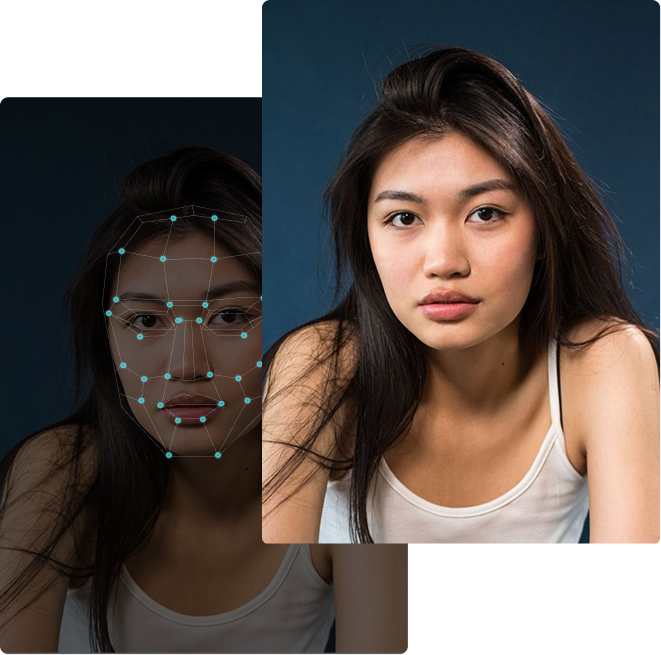




A deepfake detector can tell you an image is 92% likely to be fake. What it usually cannot tell you is why, and for anyone who has to act on that verdict, an analyst, a compliance officer, a court, why matters as much as the number. Attention maps close that gap. They turn a bare score into a picture: a heatmap laid over the image, showing which pixels the model actually looked at when it decided the face was synthetic. This is the heart of explainable deepfake detection, and it is what lets a person see the evidence rather than take a black box on faith.
This piece explains how attention maps work, what they reveal in a deepfake, why explainability has become so important, and, just as importantly, where these maps fall short. It is written for the fraud, security, and forensics teams who increasingly need not just a detection result but a defensible reason for it.
The short version is that a good detector does two jobs at once. It decides whether an image is real, and it shows its work. The second job is what turns detection into evidence.
- A deepfake detector's score answers whether an image is fake but not why; attention maps turn that score into a heatmap showing which pixels drove the decision.
- Attention maps are built with techniques like Grad-CAM (region-level), saliency maps (pixel-level), and transformer attention (which image tokens the model weighted).
- In a manipulated face, the hot regions typically fall on blending seams, the eyes, the mouth and teeth, skin texture, and the statistical artifacts of generation.
- Explainable output turns detection from a black box into evidence: an analyst gets a specific region to inspect rather than an opaque number.
- Explainability increasingly matters for governance, because regulators and auditors want AI decisions that can be understood and defended.
- Attention maps also catch a model being right for the wrong reasons, revealing reliance on background or dataset artifacts rather than real manipulation.
- The honest limits: heatmaps are an approximation of the model's reasoning, can be coarse or noisy, may differ between techniques, and show where but not what in words.
- For high-stakes and regulated use, explainable detection is becoming a requirement, not a nicety, which is why it is a core design principle rather than an add-on.
From a Score to a Heatmap: What Attention Maps Are
An attention map, also called a saliency map or heatmap, is a visualization of where a detection model focused when it made its decision. Overlaid on the original image, warm colours mark the regions that influenced the verdict most and cool colours mark the regions that mattered little. Instead of a single number, you get a spatial answer: this area, and this one, are why the model called the image fake. When those hot regions land on the parts of a face a deepfake actually alters, the map is not just interpretable, it is corroborating evidence.
The reason this is possible is that the decision is not really made by the whole image equally. A neural network weighs some features far more than others, and explainability techniques extract and render that internal weighting as a picture. The map is a window, imperfect but genuine, into which pixels carried the signal. That turns detection from an assertion into something a human can examine, question, and act on, which is exactly what high-stakes use demands.
How Attention Maps Are Made
There are a few main families of technique, and they differ in resolution and readability. Grad-CAM, or Gradient-weighted Class Activation Mapping, is the most widely used in deepfake research; it traces the gradients flowing into the final convolutional layer to produce a region-level map and, in the words of one explainer, it highlights the broad regions the model attended to when making its classification decision. Its strength is interpretability and its weakness is resolution: it can tell a reviewer the area around the eyes was significant but not pinpoint a specific blending boundary. Saliency maps go finer, computing the influence of every individual input pixel, which surfaces details like face-swap blending seams and frequency artifacts that region-level methods miss, at the cost of being noisier and harder to read.
Transformer-based detectors add a third option. Because vision transformers use a self-attention mechanism, they naturally expose which image regions, or tokens, the model attended to, and these attention maps are increasingly common in production because they tend to be more interpretable to non-technical reviewers than a gradient pattern. Perturbation-based methods round out the toolkit, altering parts of the input and watching how the score changes to infer what mattered. In practice, mature systems often combine approaches, because each answers the "where did the model look" question with a different balance of precision and clarity.
[TABLE-1]
What Lights Up in a Deepfake
When a detector flags a manipulated face, the attention map tends to concentrate on the places where synthesis leaves its marks. In a face-swap, the hottest regions are usually the blending boundaries, the seams along the hairline, jaw, and neck where a synthetic face is merged into a real head. The eyes draw attention because reflections and fine detail are hard to render consistently. The mouth and teeth light up in lip-synced or reenacted fakes, where the model has puppeted new speech, and blurred or merged teeth are a common tell. Skin regions flag when texture is unnaturally smooth or inconsistent. Research describes the underlying reason plainly: regions with the distortion characteristics and unnatural textures introduced during generation tend to carry high positive weights in the map.
The pattern also tells you something about the fake. A crisp, localized hot spot at a face boundary suggests a face-swap with a specific splice, while a diffuse map spread across the whole image can indicate full synthesis, where there is no single seam to find, or, sometimes, that the model is drawing on frequency-level statistics that do not correspond to any one visible feature. Pixel-level saliency maps are particularly good at surfacing those frequency artifacts that a coarse region map would smear over. Reading the shape of the map, not just its presence, is part of the skill.
[TABLE-2]
Why It Matters, and Where It Falls Short
The value of a heatmap is that it converts a detection result into something usable. For a human reviewer, it provides a concrete region to inspect rather than an opaque number, and, as one industry write-up notes, close attention to a facial boundary is far easier to explain to a legal team than a raw activation pattern. That readability supports trust and adoption, gives governance and audit teams a defensible record of why a decision was made, and, increasingly, meets the expectations of regulators, from the EU AI Act's emphasis on transparency to NIST's push for auditable identity systems, that consequential AI decisions be explainable. Attention maps also help catch a model that is right for the wrong reasons, revealing when it leans on the background or a dataset artifact instead of real manipulation, which is how teams diagnose and fix a detector rather than trusting it blindly.
Honesty requires naming the limits, because overselling explainability is its own risk. An attention map is an approximation of the model's reasoning, not a transcript of it, and research has shown that these maps do not always correspond to the true evidence a network used, with fidelity degrading in particular for some transformer architectures. Different techniques can produce different maps for the same image, so a heatmap is a view, not the view. The maps show where the model looked but not, in words, what the evidence means or how to act on it, which is why the field is now adding textual and multimodal explanations on top. And a very high-quality fake can yield a diffuse, unhelpful map. None of this makes attention maps worthless; it makes them one strong, interpretable signal to be read with judgment rather than treated as infallible.
Explainability as a Requirement, Not a Nicety
Put together, these points explain why explainability has shifted from a research curiosity to a procurement requirement. In media forensics and high-stakes verification, a bare real-or-fake verdict is not enough; the people who must act on it need to see and defend the basis for it, and the regulators overseeing them increasingly require the same. A detector that outputs only a score forces a reviewer to either accept it on faith or discard it, whereas one that shows which regions drove the decision lets a reviewer confirm, question, or escalate with evidence in hand. That is the difference between a black box and a tool.
This is the principle DuckDuckGoose, based in Delft, is built around: explainable deepfake detection rather than an unexplained score. DeepDetector analyzes images and video for the signatures of synthetic media and surfaces which regions drove its assessment, so an analyst sees the evidence, a compliance team gets an auditable record, and the decision can be defended, backed by ISO 27001, SOC 2, and GDPR compliance. The explainability is not a bolt-on report; it is what makes the detection usable in the settings that matter most. For more on the underlying artifacts these maps highlight, see our guide to the traces deepfakes leave, and for how that output feeds a review workflow, how a deepfake detection API fits into a fraud stack.
[TABLE-3]
Frequently Asked Questions
What is an attention map in deepfake detection?
It is a heatmap, also called a saliency map, overlaid on an image to show which regions a detection model weighted most when deciding whether the image is synthetic. Warm areas mark influential pixels and cool areas mark unimportant ones, turning a single fake-or-real score into a spatial explanation of the verdict.
How are these heatmaps generated?
Through explainability techniques. Grad-CAM uses gradients into a model's final convolutional layer to produce region-level maps, saliency maps compute per-pixel influence for finer detail, transformer models expose which image tokens their self-attention focused on, and perturbation methods alter the input and observe the score. Each trades off resolution against readability.
What regions light up when an image is a deepfake?
Usually the places synthesis leaves marks: blending seams along the hairline, jaw, and neck in face-swaps, the eyes, the mouth and teeth in lip-synced fakes, and skin with unnatural texture. Pixel-level maps can also surface frequency artifacts. A crisp local hot spot suggests a splice, while a diffuse map can indicate full synthesis.
Why does explainability matter for deepfake detection?
Because people have to act on the result. A heatmap gives an analyst a concrete region to inspect, supports trust and adoption, provides an auditable record for governance and regulators, and helps catch a model that is right for the wrong reasons. In high-stakes and regulated settings, a defensible reason for a verdict is as important as the verdict itself.
Are attention maps a perfect explanation of the model's reasoning?
No. They are an approximation, and research shows they do not always match the true evidence a network used, with fidelity varying by architecture. Different techniques can produce different maps for the same image, and they show where the model looked but not, in words, what it means. They are a strong interpretable signal to read with judgment, not an infallible one.
Can attention maps detect frequency artifacts?
Partly. Coarse region-level methods like Grad-CAM tend to smear over them, but pixel-level saliency maps can surface the fine statistical patterns that generation leaves, which is one reason mature systems combine techniques. Some generation artifacts, however, live in the frequency domain and do not map neatly onto any single visible feature.
Do regulators require explainable AI detection?
Increasingly, the direction is that way. Frameworks such as the EU AI Act emphasize transparency, and identity standards like those from NIST push for auditable systems, so consequential AI decisions are expected to be explainable and defensible. That is why explainability in detection is moving from a nice-to-have to a procurement and compliance expectation.

About the author