













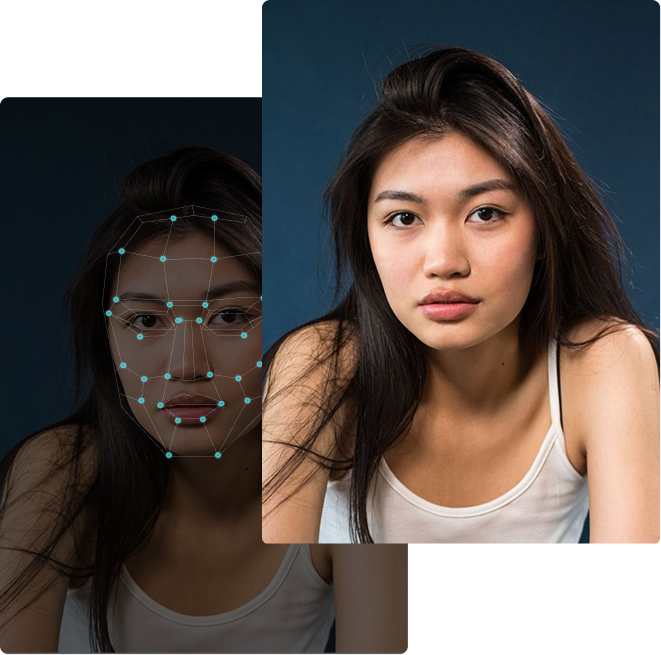

.webp)


Yes. A single photograph is enough to generate a deepfake in 2026. Face animation tools, one-shot face swap models, and diffusion-based reenactment systems can all take one still image and produce a talking, blinking, head-turning video in minutes. The technical barrier that once required hundreds of training images per person has collapsed.
For identity verification providers, financial institutions, and anyone responsible for digital onboarding, this answer matters. The assumption that a live selfie or short video clip is difficult to fake from a single source image is no longer accurate. Fraudsters use one scraped photo from a social media profile to generate convincing video presentations against KYC liveness checks. In 2024, deepfake attacks occurred at a rate of one every five minutes globally (Entrust). Virtual camera injection attacks against identity verification platforms surged 2,665% in 2025 (iProov), and standard liveness checks catch exactly 0% of high-quality injection attacks.
This guide explains how single-photo deepfake generation works, which attack categories it enables, where the quality limits still exist, and what detection infrastructure actually catches it.
- A single photograph is sufficient to generate a deepfake video using face reenactment, one-shot face swap, or image-to-video diffusion tools. No per-person training is required.
- Standard passive liveness detection catches 0% of virtual camera injection attacks, the primary delivery mechanism for single-photo deepfakes in KYC flows.
- Virtual camera injection attacks against IDV platforms increased 2,665% in 2025 (iProov).
- Single-photo deepfake quality is highest in short clips of 3 to 15 seconds, exactly the length of a liveness verification prompt.
- Detection requires frequency domain analysis, temporal inconsistency detection, and injection path detection. Human review achieves only 24.5% accuracy on high-quality deepfakes.
- Deepfake fraud attempts have risen 2,137% over three years, from 0.1% to 6.5% of all fraud attempts (Signicat).
What Is a Single-Photo Deepfake?
A single-photo deepfake is synthetic media that uses one source image to animate or transplant a person's face into a video or live video stream, without requiring the attacker to gather additional training data. The result can range from a short animated clip to a real-time video feed.
Three distinct techniques produce this output.
From a single scraped photo to a liveness bypass
The barrier that once needed hundreds of training images per person is gone. One still feeds any of three one-shot techniques, and all three converge on the same target: a verification check that thinks it's seeing a live human.
No training
Face reenactment, also called face animation. A still photo is used as the identity source. A driving signal, which can be another video of a different person, an audio track, or a text prompt, controls the motion. The model transfers head pose, facial expressions, eye movement, and lip sync onto the source face while preserving the identity from the original photograph. The output is a video of a person who was never recorded.
One-shot face swapping. The attacker's source identity is extracted from a single image as a compact identity embedding. That embedding is injected into a StyleGAN2 or diffusion decoder, which replaces another person's face in an existing video frame by frame. No per-person training is required. Tools like Deep-Live-Cam, InSwapper, and various commercial APIs do this in real time.
Image-to-video synthesis. Newer generative models, including Runway Gen-3, Luma Dream Machine, and video diffusion pipelines, take a single image as a starting frame and hallucinate realistic motion forward from it. A photo of a person's face becomes a video of that person speaking, reacting, or moving.
All three approaches can defeat passive liveness checks, which only confirm that a frame contains a plausible human face. Only active temporal analysis and injection detection reliably separate these outputs from genuine video.
What Is a Deepfake?
A deepfake is any synthetic or manipulated audio-visual media produced using deep learning, typically a generative adversarial network (GAN) or diffusion model, that depicts a real person saying or doing something they did not actually say or do.
The term originated from autoencoder-based face-swap systems published in 2017 and 2018. Those early systems required hundreds of images per identity to train shared encoder networks with separate decoders. The output was crude, with visible blending artifacts around the face boundary and poor generalization to non-frontal angles.
The technical architecture shifted through three generations. First-generation models needed per-identity training. Second-generation GAN systems like SimSwap and FSGAN extracted identity embeddings that could be conditioned at inference without retraining. Third-generation diffusion-based systems such as DiffusionAct perform one-shot reenactment without per-subject fine-tuning, producing results that state-of-the-art GAN methods cannot match on background fidelity and artifact suppression.
The practical result: the same quality that required 56 hours of rendering to produce the 2018 BuzzFeed Obama deepfake is now achievable in under an hour with free software.
How Does Single-Photo Deepfake Technology Actually Work?
The pipeline has four stages regardless of which specific technique is used.
Stage 1: Identity Extraction
The model processes the source photograph to extract a facial identity representation. This is typically a high-dimensional embedding vector, a 3D morphable model (3DMM) reconstruction, or a latent code in GAN or diffusion model space. The embedding captures appearance features (skin tone, facial geometry, texture) and identity features (the specific combination that makes the face recognizable as that person) separately from pose and expression.
Modern identity extractors like ArcFace are trained on millions of faces and produce embeddings robust to lighting variation, partial occlusion, and moderate angle changes. A frontal, well-lit photograph produces the cleanest extraction. A low-resolution or heavily angled photo degrades the output, but many consumer tools include GFPGAN post-processing to restore resolution artifacts in real time.
Stage 2: Motion Generation
The driving signal controls what the synthesized face does. Depending on the attack use case, the driving signal can come from several sources.
A video of a different person performing the desired motions is the most common option in fraud tools. The model transfers only the motion parameters, not the identity, onto the source face.
An audio track combined with a lip-sync model (sadTalker, Wav2Lip, and similar architectures) generates mouth region animations timed to the phoneme sequence in the audio.
A text or motion prompt fed into a video diffusion pipeline produces plausible motion consistent with the described action. A 3D parametric face model providing explicit pose and expression parameters generates the most controllable output and is used in tools that produce custom facial responses.
Stage 3: Rendering and Blending
The driven motion parameters are decoded back into pixel space. This step determines output quality more than any other. GAN-based decoders produce sharp but sometimes artifact-prone outputs, particularly in non-frontal angles and around hair, glasses, or other occlusions. Diffusion decoders produce higher fidelity background reconstruction and better handling of accessories but have higher computational cost.
Blending algorithms composite the synthetic face region into the surrounding frame. Boundary artifacts, the most visible tell in first-generation deepfakes, are largely eliminated in current tools by soft masking and neural in-painting. The remaining artifacts are often at sub-pixel level, detectable by frequency analysis but not by casual human viewing.
Stage 4: Post-Processing and Delivery
Face restoration models (GFPGAN v1.4, CodeFormer) run as a post-processing step to enhance resolution and suppress remaining artifacts. For attack use cases, the output is then injected into the verification pipeline via a virtual camera driver that intercepts the video feed before it reaches the KYC application.
What Types of Deepfake Attacks Use a Single Photo?
Table 1: Single-photo deepfake attack types, mechanisms, and threat levels across primary target sectors
Single-photo capability is most directly relevant to four attack categories.
KYC liveness bypass via face reenactment. The attacker animates a stolen or synthetically generated identity photo to satisfy active liveness prompts. The synthetic face blinks, nods, and turns in response to the verification system's prompts. Passive liveness checks, which only confirm that the frame looks like a human face, pass at zero detection rate. The World Economic Forum's January 2026 Cybercrime Atlas found that most consumer face-swap tools defeat standard biometric onboarding checks when paired with virtual camera injection.
Face-swap injection into video calls. Real-time tools overlay the attacker's appearance with a target identity extracted from a single photograph, frame by frame in a live Zoom, Teams, or WebEx session. The finance worker in the Arup case was deceived by a deepfake video call that impersonated the company's CFO and multiple colleagues. The attacker needed only photographs of the impersonation targets.
Synthetic identity document fraud. A single photo generates the face image component of a fraudulent identity document. Digital document forgeries increased 244% year-over-year in 2024 and accounted for 57% of all document fraud detected globally.
Social engineering and scam content. Animated photos of celebrities, executives, or romantic partners are used in investment scams, impersonation fraud, and non-consensual imagery. Deepfake fraud attempts have risen 2,137% over three years, from 0.1% of all fraud attempts to 6.5%.
What Are the Quality Limits of Single-Photo Deepfakes?
Single-photo generation trades training depth for accessibility. Several quality constraints remain in 2026, though all are narrowing.
Angle generalization. Most face reenactment systems are trained predominantly on frontal and near-frontal views. Extreme profile poses, roughly beyond 45 degrees from center, produce visible distortion in the rendered face region. The source photo's angle partially constrains what head poses the model can plausibly synthesize. Systems that incorporate 3DMM-based pose estimation extend this range but do not fully eliminate the constraint.
Occlusion handling. Hair, glasses, scarves, and other objects that partially cover the face in the source photograph create artifacts in the output. Neural in-painting fills these regions but introduces inconsistencies that forensic tools can detect. Occlusion is one of the cleaner detection signals in current forensic pipelines.
Temporal consistency at scale. Short clips of 3 to 15 seconds from single-photo sources are generally coherent. Longer sequences degrade, particularly in facial texture consistency across frames. This matters for extended live video calls but is less relevant for short liveness verification prompts.
Low-resolution source material. A low-resolution source photograph limits the maximum output quality. GFPGAN post-processing recovers some detail but introduces a characteristic over-smoothed skin texture that trained detectors can flag.
Identity drift. In image-to-video diffusion systems, the generated video gradually drifts away from the source identity as the sequence length increases. The face in frame 200 resembles but is not identical to the face in frame 1. This limits use in extended impersonation scenarios but does not significantly impact short verification prompts.
Table 2: Quality comparison between single-photo and multi-image deepfakes across key forensic dimensions
How Does Single-Photo Deepfake Detection Work?
Standard liveness detection was designed to defeat printed photos, screen replays, and pre-recorded videos shown to a camera. It catches 99% or more of those attacks. Against a well-executed single-photo deepfake delivered via virtual camera injection, the same system catches 0%, because the injected feed bypasses the camera hardware entirely. Detection requires different signals.
Same liveness check: 99% vs 0%
Passive liveness was built to catch a fake shown to the camera. It does that well. But a single-photo deepfake injected through a virtual camera never touches the lens, so the detector never sees the attack surface it was designed for.
Closing the gap needs signals liveness doesn't use: frequency-domain artifacts, temporal inconsistency, and injection-path detection, reading the stream itself, upstream of the camera intercept.
Frequency domain analysis. Real camera sensors introduce characteristic noise patterns and compression artifacts. Deepfake generators, which operate in pixel space, produce outputs with different frequency signatures detectable by Fast Fourier Transform (FFT) analysis and similar spectral methods. This signal is present even when the deepfake is visually indistinguishable from authentic footage.
Temporal inconsistency detection. Human faces have micro-expressions, eye reflections, and subtle muscle movements that are continuous across frames. Deepfake sequences produced from a single source image generate these signals independently for each frame or short clip. Temporal analysis across 10 or more frames detects discontinuities that single-frame analysis cannot see.
Injection path detection. Virtual camera drivers leave metadata signatures in the video feed. Legitimate camera hardware interacts with the operating system in specific ways that virtual drivers replicate imperfectly. SDK-level capture that reads from the hardware layer before the OS intercept point blocks the injection path entirely.
3D depth and lighting consistency. Two-dimensional deepfake renderings do not produce accurate depth maps. Infrared sensors and structured light systems used in hardware-level liveness detection provide signals that 2D synthetic media cannot replicate. The attacker would need a 3D rendering pipeline, not just a single photograph, to defeat these checks.
Multi-frame identity consistency. Face recognition models that extract identity embeddings from multiple frames and compare them can detect the identity drift that characterizes extended deepfake sequences.
DuckDuckGoose's DeepDetector applies a multi-signal approach that combines temporal analysis, frequency artifact detection, and injection path verification across both image and video modalities, producing forensic-grade outputs that flag single-photo reenactment attacks at the point of KYC capture.
Who Should Be Concerned About Single-Photo Deepfake Attacks?
Table 3: Industries at highest risk from single-photo deepfake attacks with supporting incident data
Identity verification providers. KYC and eKYC platforms are the primary attack surface. iProov reported a 2,665% increase in native virtual camera attacks in 2025, the single fastest-growing deepfake attack vector. Every 15 seconds of verification footage contains enough driving signal to animate a source photo through a complete liveness prompt sequence.
Financial institutions. Gartner's 2025 survey of 302 organizations found 62% had experienced a deepfake attack in the prior 12 months. The average loss per deepfake-related incident in 2024 was approximately $500,000, with large enterprises reporting losses up to $680,000.
Crypto exchanges and fintechs. Cryptocurrency platforms face the highest deepfake fraud attempt rate of any sector, at 9.5% of all fraud attempts in 2024. The combination of high-value transactions, fully remote onboarding, and regulatory arbitrage between jurisdictions makes them a concentrated target.
HR and remote hiring teams. KnowBe4 discovered in July 2024 that a newly hired software engineer was a North Korean operative using an AI-manipulated photo and a deepfaked video presence across four interview rounds. A single professional headshot was sufficient to build a convincing video presence.
Anyone with a public social media presence. The source material for a single-photo deepfake is any photo that appears online. The attack surface includes every public-facing professional profile, news article image, conference presentation slide, or company website headshot.
FAQ
Can a deepfake be made from one photo?
Yes. One-shot face animation and face reenactment tools produce video deepfakes from a single source image without additional training data. The technology is commercially available, requires no programming skills, and produces output capable of defeating standard passive liveness checks.
How realistic is a deepfake made from one photo?
Quality depends on the source photo resolution, viewing angle, and the tool used. In short clips of 3 to 15 seconds, at resolutions typical of video calls and KYC verification flows, single-photo deepfakes are difficult for unaided human viewers to identify. Studies show human detection accuracy for high-quality video deepfakes averages 24.5%.
What makes single-photo deepfakes harder to detect than multi-image deepfakes?
The key detection challenge is not the quality of the deepfake itself but how it reaches the verification system. Virtual camera injection bypasses the physical camera hardware, meaning presentation attack detection systems never see the original attack surface. Standard liveness checks pass at 0% detection rate against high-quality injection attacks.
What is face reenactment?
Face reenactment is a deepfake technique that takes a source identity image and transfers the pose, expressions, and movements from a driving video or audio signal onto it. The result is a video of the source person performing motions they never performed. It is the primary technique used to animate a single photograph.
Can you detect a deepfake made from one photo?
Yes, with the right infrastructure. Frequency domain analysis, temporal inconsistency detection, injection path detection, and multi-frame identity consistency analysis all provide signals that single-photo deepfakes cannot fully suppress. Standard liveness checks alone are not sufficient.
How much does it cost to make a deepfake from a single photo?
Consumer tools capable of producing single-photo deepfakes are available at no cost (open-source) or for less than $10 per month on commercial platforms. The technical barrier is approximately the cost of a mid-range smartphone and an internet connection.
What is a one-shot face swap?
A one-shot face swap is a face replacement technique that requires only one photograph of the target identity. A pre-trained identity encoder extracts a compact embedding from the photo, which is used to condition a generative decoder that replaces faces in video frames. No per-person training is required.
Which industries face the highest risk from single-photo deepfake attacks?
Financial services, identity verification, cryptocurrency exchanges, and remote hiring workflows face the highest exposure. Crypto platforms reported 9.5% of all fraud attempts involved deepfakes in 2024. Fintech saw a 700% surge in deepfake incidents in 2023.
Last update: Q2 2026

About the author